Adventure and exploration. Two words that have been making a strong comeback in the world of mountain biking in recent years. And perhaps they're the best words to describe the CST Rock Hawk, a tire that's difficult to pinpoint at first glance, but which reveals a decidedly interesting personality after a few kilometers.
A strange tire. At least at first glance.

When I received the CST Rock Hawk, my first reaction was a bit of skepticism.
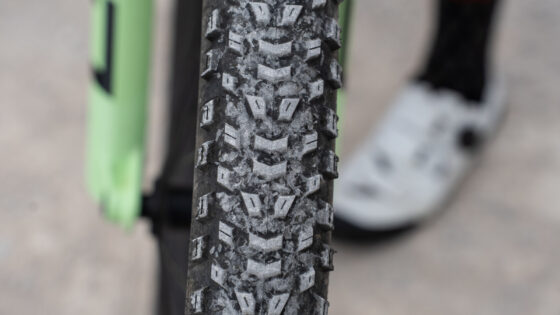
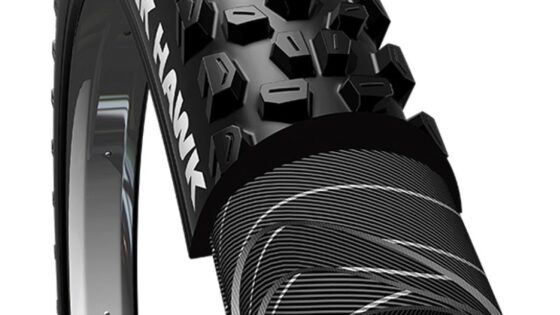
The profile is unique, almost atypical compared to what we're used to. It doesn't look like a true gravity tire, but at the same time, it doesn't look like a classic XC tire designed for maximum smoothness.
In short, looking at it from a standstill, it's natural to ask: where do I put it?
Assembly, meanwhile, is incredibly simple. Just pop it up, inflate it, and off you go. And it's when the wheels start turning that many of your initial doubts disappear.
What at first glance might seem like a somewhat anonymous eraser, or at least difficult to contextualize, gradually transforms into something much more interesting: a true link between two worlds.
The downcountry one and the enduro one.
In the middle is the adventure

But what exactly does that mean?
In recent years, mountain bike categories have become increasingly less rigid. XC bikes have slacker geometries, more generous suspension, and downhill capabilities that would have seemed unthinkable just a few seasons ago.
At the same time, many modern enduro bikes have become less extreme and more versatile, capable of pedaling better and easily tackling even days when the stopwatch counts for nothing.
And it is precisely in this space that the Rock Hawk finds its dimension.
A space that we could define with just two words: adventure and exploration.
On an XC, when the trail continues beyond the race course

Let's think of a modern bike cross country: open geometry, good travel, low weight and the ability to tackle technical terrain with a safety that was unthinkable until a few years ago.
By fitting a tire like the Rock Hawk, that same bike can change its character slightly.
It doesn't become an enduro, obviously. But it acquires that extra dose of safety that can make the difference when you move from a classic XC ride to a long alpine excursion, where the terrain becomes rougher, the descents longer, and the conditions less predictable.
Here we're no longer talking about chasing tenths of a second or maximum efficiency on a race track. We're talking about setting off in the morning without knowing exactly what we'll encounter during the day.
Rocks, roots, natural trails, transfers, long climbs and descents where having a little more rubber under you means above all being able to ride with greater peace of mind.
The Rock Hawk, on a modern XC bike, seems to be saying just that: go further. Explore.
The opposite happens on enduro.

Then there is the other side of the coin.
I also tried the Rock Hawk on my Commencal V5 and here the result is, in some ways, even more curious.
If on an XC it adds safety and widens the terrain of use downwards, on an enduro it does exactly the opposite: makes the bike smoother and more pleasant to pedal.
The difference on flat sections is noticeable and, in my tests, translates into approximately 2 km/h more compared to more aggressive configurations.
A fact that only tells part of the story.
The most interesting thing is the feeling of suddenly owning an enduro bike that makes you want to ride more. To take a dirt road just to see where it leads. To connect two trails with a long transfer. Or simply to go out without necessarily aiming for the most extreme descent in the area.
And this fits perfectly with a new generation of enduro bikes which, compared to some extremely specialized models of the past, are once again becoming more versatile vehicles.
A bike you can ride for a day on the trails or even for a long excursion.
Smoother, without forgetting the descent

Of course, making an enduro bike smoother would make little sense if the price to pay was to completely give up safety when the trail heads downhill.
And this is where the Rock Hawk finds its balance.
Despite its greater propensity for pedaling, it remains a tire that allows you to confidently tackle even rough terrain and keep pushing when the time comes to let go of the brakes.
And this is probably its most interesting aspect.
It's not intended to be the absolute best tire in a single discipline. Rather, it seeks to perform well when, within the same lap, disciplines begin to mix.
When the climb is long, the transfer is even longer and then, suddenly, a real descent appears in front of the wheel.
Is it a race tire?
At this point the question is inevitable: Is the CST Rock Hawk a racing tire?
I would say no.
If the goal is pure performance, the stopwatch and the pursuit of every last second, it makes more sense to orient ourselves towards tires specific to the discipline we practice.
An XC racing tire will be more suitable for an XC race. A specialized gravity tire will offer additional advantages when the sole goal is to go as fast as possible on the descents.
But perhaps judging the Rock Hawk exclusively by the stopwatch means not having fully understood its character.
Because this tire seems to be designed for something else.
Adventure and exploration
The CST Rock Hawk is for those who see mountain biking first and foremost as a tool for discovery.
For those who want to tackle a long ride with good comfort, pedal without dragging excessively heavy or slow tires and, at the same time, have enough safety when the terrain becomes technical.
It's for those who start with a GPS track but occasionally decide to ignore it.
For those who see a dirt road going up a hill and think: who knows where it leads.
For those who connect paths, cross mountains, clock up kilometers and maybe return home later than expected because, at a certain point, they decided to take that detour they hadn't planned.
In a market where we are used to dividing everything into increasingly precise categories — XC, downcountry, trail, all mountain, enduro — the Black Hawk almost seems to want to go in the opposite direction.
Fewer labels, more possibilities.
And perhaps this is precisely its strong point.
It's not necessarily the tire for those who want to be the fastest.
It's the tire for those who want to go further.
Because, in the end, mountain biking can also be this: adventure, exploration, and that irrational desire to discover what's on the other side of the hill.