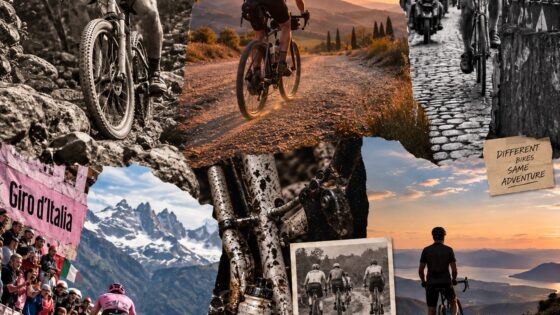
For many years, cycling had fairly easy-to-distinguish boundaries. On one side was the road, on the other, mountain biking. Pavement or dirt. Speed and efficiency or technique and the ability to tackle the most challenging terrain.
Then these boundaries began to become much less clear.
Gravel is probably one of the most interesting expressions of this transformation, because more than inventing a new terrain to ride, it has changed the way we choose where to go. And the new Scott Addict Gravel is a good starting point for understanding how much this category has evolved.
While MTBs were going electric, gravel was taking a different path
In recent years, the e-bike has profoundly changed the face of mountain biking. Not only from a commercial standpoint, but also in the way off-road riding is experienced.
E-MTBs have vastly expanded the range of riding, made previously challenging elevation gains accessible, and transformed the climb from a price to pay to reach a descent into an integral part of the fun. They've made it possible to ride farther and longer, and, most importantly, they've opened mountain biking to a much wider audience.
At the same time, however, another part of cycling followed an almost opposite direction.
Gravel didn't seek greater power or the ability to overcome increasingly challenging obstacles. It sought something much simpler: the ability to not worry too much about the type of road ahead.
It's not necessarily a simplified MTB, nor even a beefed-up road bike. It's a bike that allows you to combine asphalt, dirt roads, forest roads, cycle paths, easy trails, and connections that normally belong to different worlds.
And it is perhaps precisely this independence in choosing the route that has decreed the success of gravel.
The dirt road doesn't have to be difficult
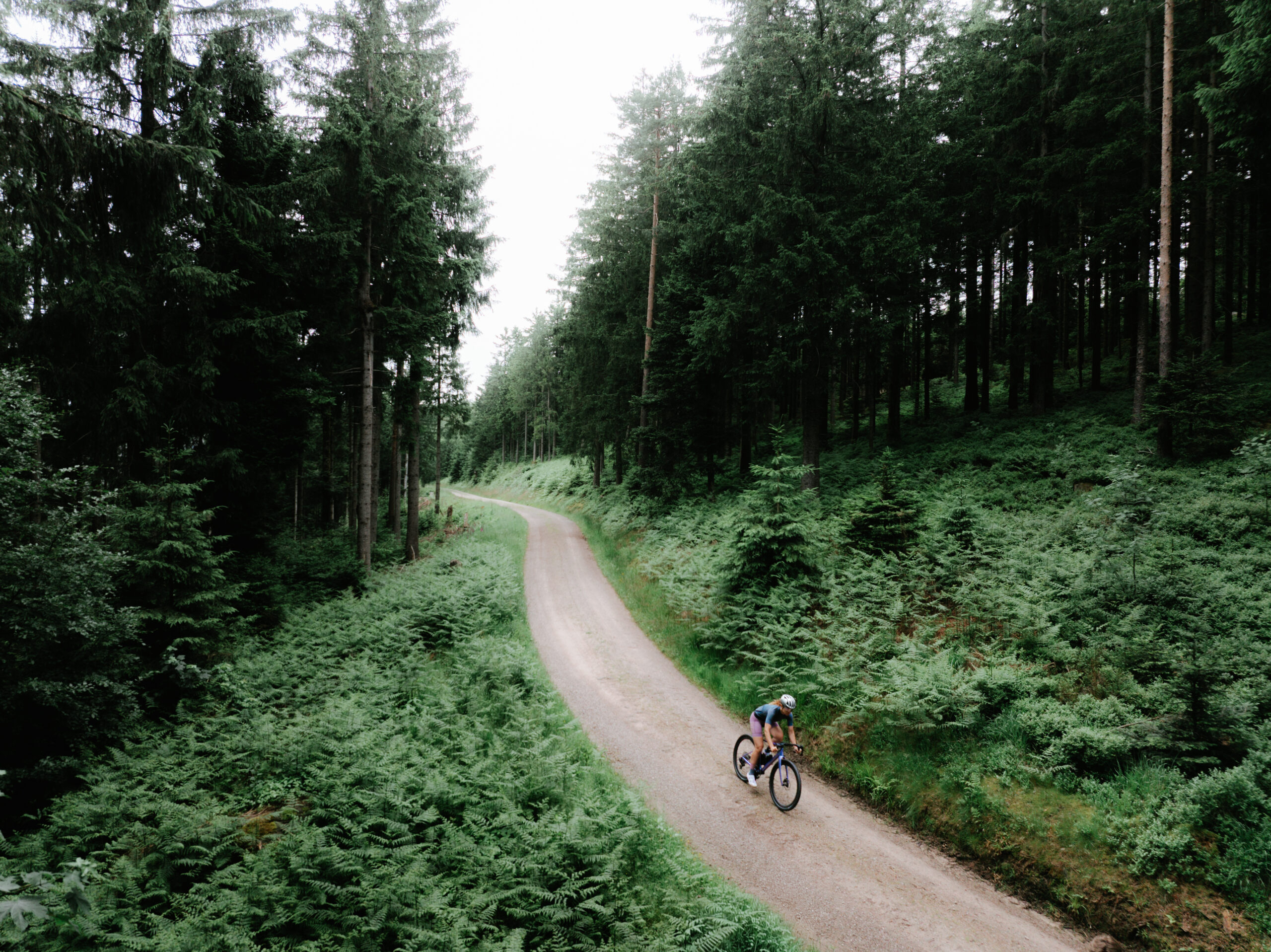
One of the most interesting differences compared to contemporary mountain biking is cultural rather than technical.
MTBs have continued to increase their capabilities: more effective suspension, more aggressive geometry, higher-performance tires, and, with the arrival of e-bikes, an ability to tackle climbs and distances previously unimaginable.
Gravel followed a different logic.
Dirt roads don't have to be technical to be interesting. A forest road through a wood, a farm road, a forgotten secondary climb, or simply a detour we're not sure where it will lead can become the very reason for the outing.
Performance remains, of course. Gravel racing is now an extremely competitive discipline and has produced increasingly specialized bikes.
But in parallel, a different gravel continues to exist, probably even closer to the origin of the phenomenon: that of exploration.
Start without having to build an exclusively road or exclusively off-road route.
A transversal bike
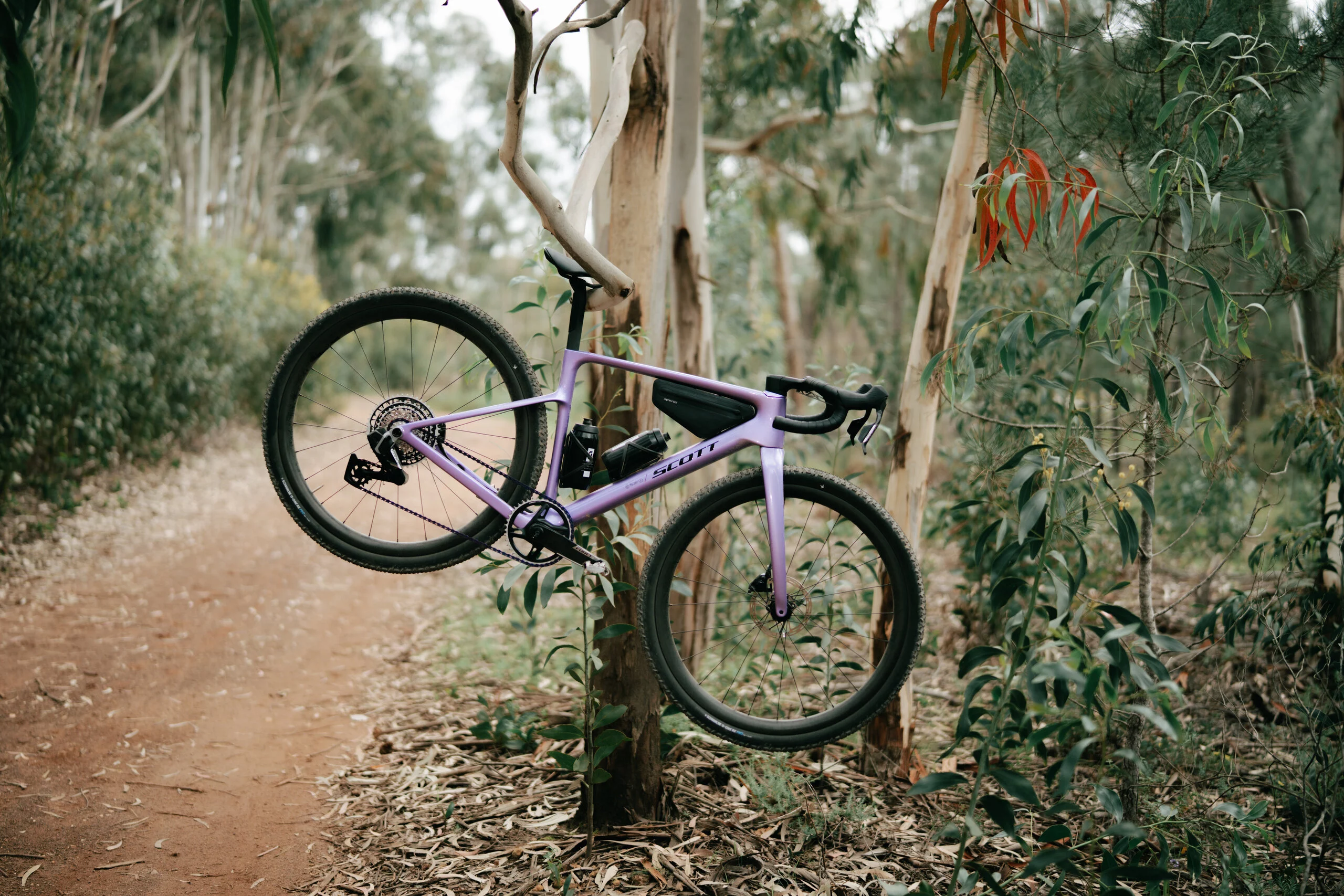
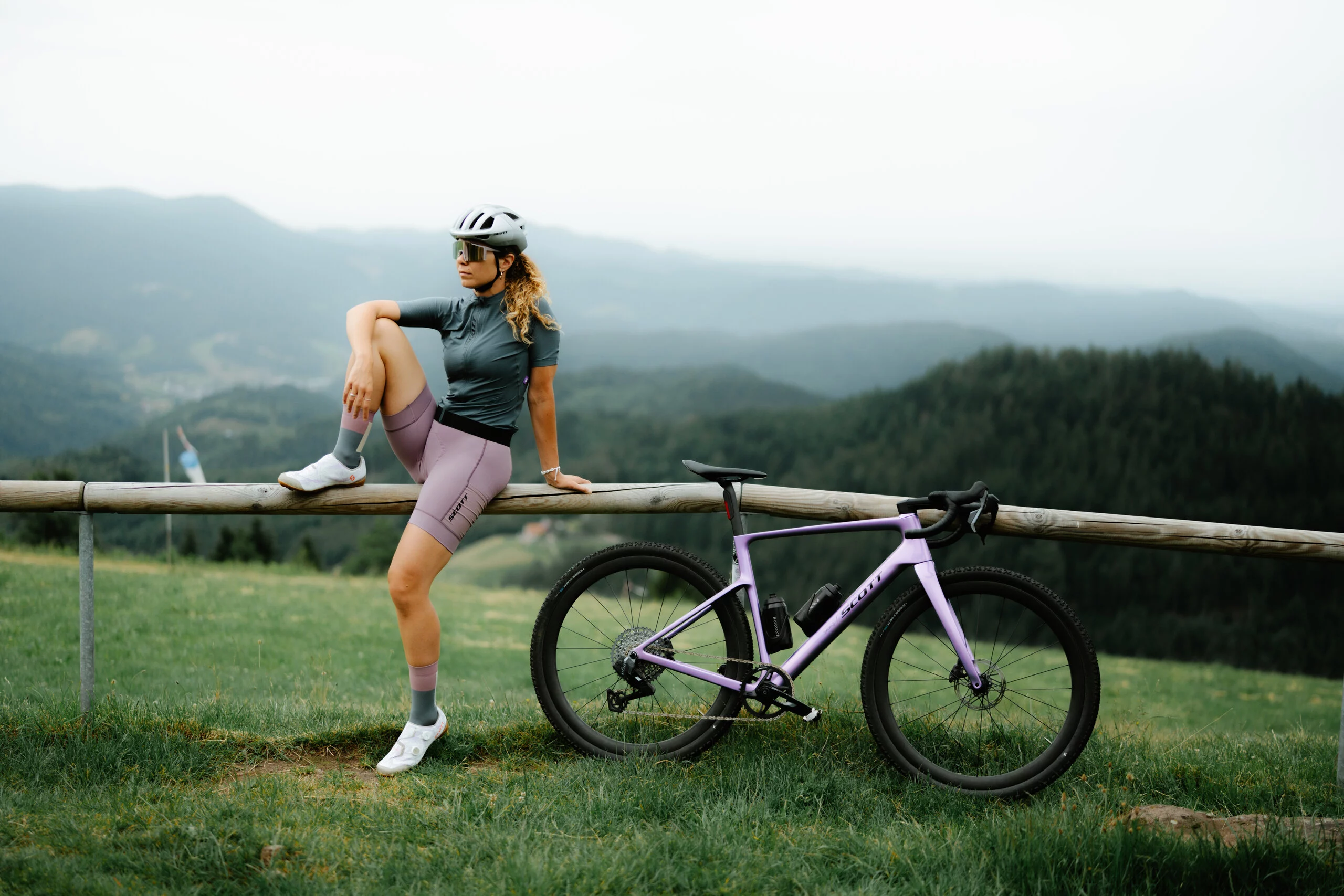
The new Scott Addict Gravel seems to have been born exactly within this interpretation.
Scott presents it with a very simple concept: sometimes the best part of a ride is not knowing exactly where it will take us.
That's why the new generation focuses on comfort, stability on different surfaces, and the ability to carry everything you need to stay out longer. Not just speed on dirt, but versatility.
The data that probably best describes the evolution of the bike is the wheel clearance.
The Addict Gravel can accommodate tires up to 57mm and comes standard with 50mm tires. It's even compatible with 2,2-inch MTB tires.
A few years ago, such measurements on a drop-bar bike would have seemed almost excessive. Today, however, they reveal how far gravel has moved from the initial idea of a simple racing bike with slightly larger tires.
And above all, they allow the cyclist to decide what character to give to his bike.
More comfort, less obsession with stiffness

The direction chosen in the design of the frame is also interesting.
In competitive cycling, we've been accustomed for years to almost automatically considering stiffness a positive value. Stiffer meant better performance.
In gravel the equation is less simple.
Scott says it has deliberately reduced the overall stiffness of the new Addict Gravel slightly to improve traction and ability to adapt to irregularities in the terrain.
Vertical comfort is also an important part of the project. The new fork uses curved seatstays and a revised head tube to achieve, according to Scott, a 30% increase in front-end compliance. At the rear, the combined work of the seat tube, lowered seatstays, and top tube results in a claimed increase in compliance of up to 60% compared to the previous Addict Gravel used with a rigid seatpost.
Numbers aside, the principle is especially interesting.
A bike designed for long hours on different surfaces must not only be fast. It must allow the rider to continue pedaling well as the hours increase and the surface deteriorates.
Geometries that follow tires and use
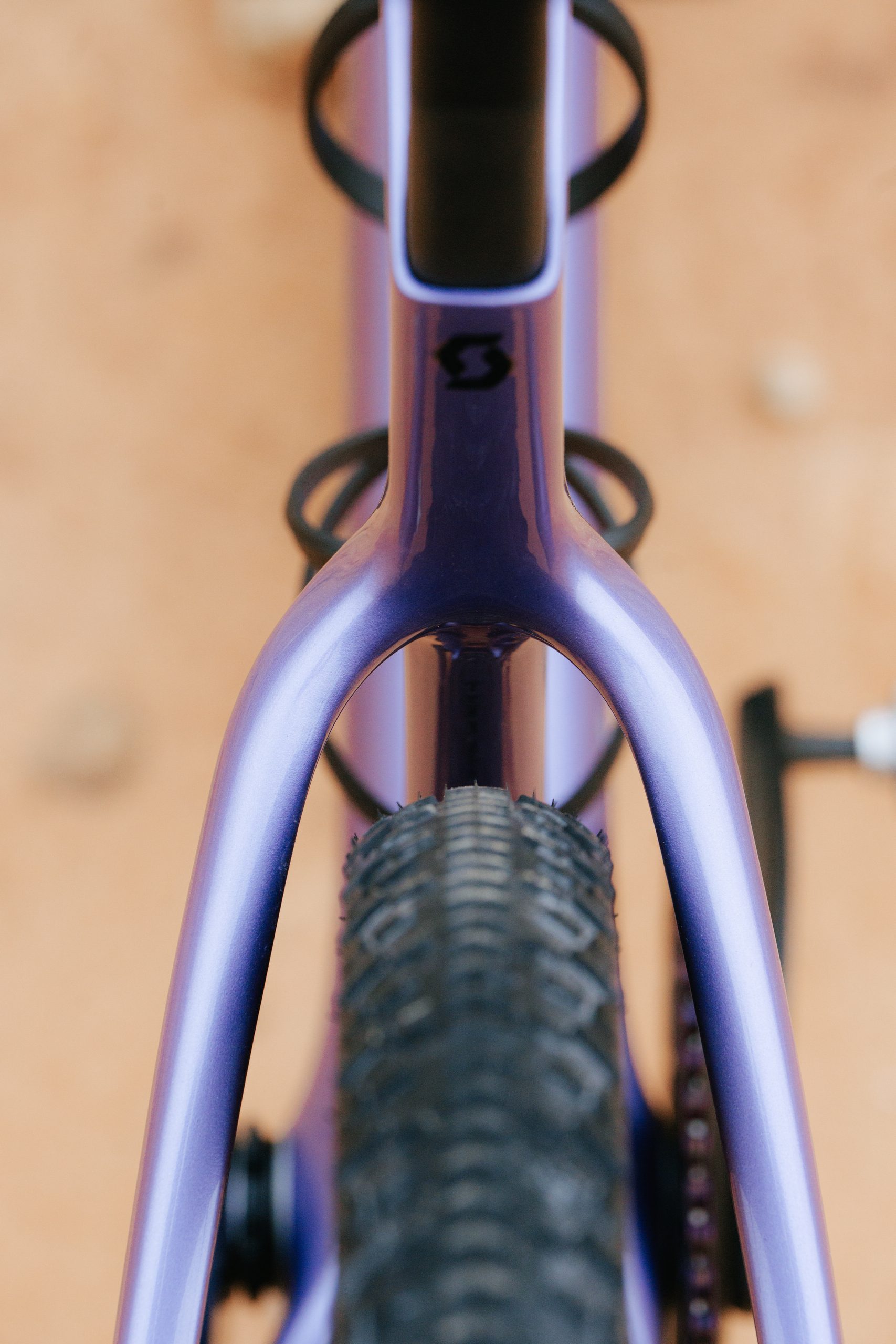
The geometry also changes accordingly.
The stack height has grown by 10mm, while the frame's reach has also increased, offset by a 10mm shorter cockpit. The bottom bracket has been lowered to accommodate larger tires, while increased fork rake and a longer front center position bring the front wheel further forward.
The goal is to gain greater confidence at high speeds and when the terrain becomes more technical, without losing the feel of a responsive bike.
It is significant, however, that Scott has maintained a riding position close to that of the street Addict.
And this is where the transversal nature of gravel emerges once again: retaining some of the efficiency and position of a road bike, while greatly increasing the number of routes on which that same position can be used.
Bring what you need with you
Then there is another aspect that has become central to gravel: self-sufficiency.
The Addict Gravel integrates space into the frame for an inner tube, levers and mini-pump through the Syncros Save the Day system. At the ends of the handlebars there is space for a wrench and the necessary for tubeless repairs.
There is a dedicated bag under the top tube, removable when not needed, and there are mounts on the fork to add water bottles.
Scott has even worked on their position: the mounts are placed on the inside of the fork blades and the dedicated brackets bring the weight closer to the steering axis, reducing inertia by 35% according to the manufacturer.
These are technical details, but they tell a bigger story.
The bike is not designed just to tackle a specific terrain, but to allow the cyclist to step away, carry water and gear, solve a problem and continue.
Gravel doesn't necessarily mean going slow
However, all this does not mean giving up on performance.
The Addict Gravel HMX frameset weighs a claimed 794 grams, 75 grams less than the previous generation. The HMF version, on the other hand, tips the scales at a claimed 990 grams.
The complete Addict Gravel Premium is rated at 7,8kg, while the range goes up to 8,7kg for the 30 and 40 versions.
The cockpit has also been completely redesigned for gravel, with work on the wrist position, the transition between the upper body and the controls, and the shape of the drops, with the aim of increasing control and comfort.
The result is a bike that doesn't sacrifice its sporty component. It simply no longer considers it the sole criterion by which to judge the project.
Gravel means above all choosing
Maybe this is why gravel continues to be interesting.
Not because it invented a new way of riding. Many of the things we call gravel today existed long before anyone decided to give them a name.
The new thing is having built bicycles around that idea.
While one aspect of mountain biking has used the electric motor to greatly expand what a mountain bike can do, gravel has expanded the territory of cycling in a different way: reducing the importance of borders.
Asphalt or dirt become less important categories. What matters is being able to switch from one to the other without constantly wondering if the bike is the right one.
The new Addict Gravel takes this concept quite a step further: 50mm tires with clearance up to 57, the ability to fit MTB tires, increased comfort, space for tools and luggage, fork mounts, and at the same time a frame that in the HMX version stays under 800 grams.
It's not a mountain bike and it doesn't want to be.
It's not even just a road bike capable of tackling a few miles of dirt roads.
It's something that's somewhere in between. Or perhaps, and this is the most interesting part of gravel, it's a bike that tries to make it increasingly less important to determine where exactly that medium is.