


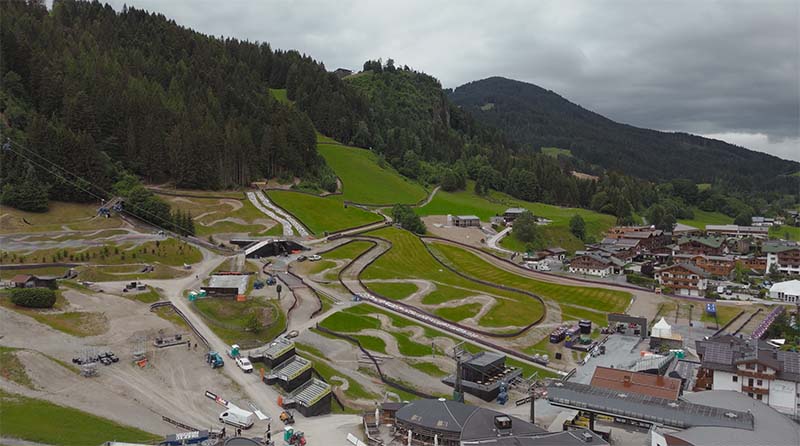
Before the race, there's another race: how a MTB World Cup paddock is born
We're used to entering the paddock when everything is already in place. Perfect stands, bikes on stands, mechanics hard at work, and riders focused on the race. But what happens before? In Leogang, we went behind the scenes with MS-RACING and BOA® to discover how an empty space transforms, in just a few days, into the operational heart of a World Cup team.
When we arrive at an MTB World Cup event, the paddock almost feels like a small city.
Perfectly lined up trucks, hospitality areas, mobile workshops, bicycles ready on stands, compressors, spare parts, tools, and people moving about following a seemingly time-honored routine.
We walk through it almost without noticing. It's where we meet the riders, where we photograph the new bikes, where we look for interesting technical details, and where, between one test and the next, we can soak up much of the race atmosphere.
But that city, a few days before, it simply didn't exist.
In its place was asphalt, gravel and empty spaces.
And then the question arises spontaneously: How do you build a World Cup paddock?
Before the riders arrive trucks and cranes
In Leogang we followed the work of MS-RACING, together with Markus Stöckl, founder and team owner, to see what happens when stopwatches and bicycles are still far from being the protagonists.
The first image is very different from what we normally associate with the World Cup.
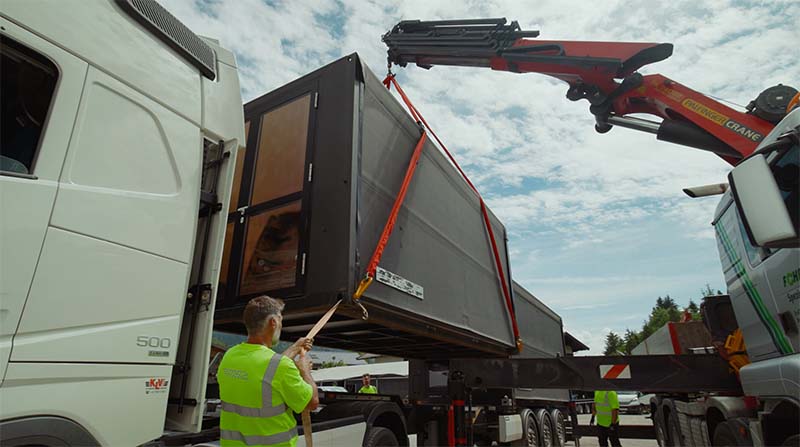
Trucks and containers arrive. The cranes begin work. Materials, structures, and equipment must be unloaded and, above all, placed in exactly the right place.
And MS-RACING is certainly not alone.
At the same time, dozens of teams are doing exactly the same thing. The paddock thus becomes a huge three-dimensional puzzle in which each team must build its own space according to time, dimensions, and logistics.
The MS-RACING container is lifted from the truck and slowly driven into position.
A few centimeters can make a difference.
Because that's just the first piece.
From an empty space to a small racing workshop
Once the main structure is in place, the transformation begins.
Platforms and covers are assembled, the structures are aligned, and the workbenches arrive. Tools are stored, as are spare parts, wheels, components, and anything else you might need over the weekend.
Gradually, what looked like a parking lot a few hours earlier began to resemble the paddock we know.
And here we understand an aspect that is easy to underestimate from the outside: the organization of space is part of the performance.
When practice and qualifying begin, there won't be time to wonder where a certain tool has gone or where to find a component. A mechanic should be able to get his hands on what he needs almost automatically.
Everything has a place.
And that spot is decided before the first bike rolls off the truck.
It's very physical work.
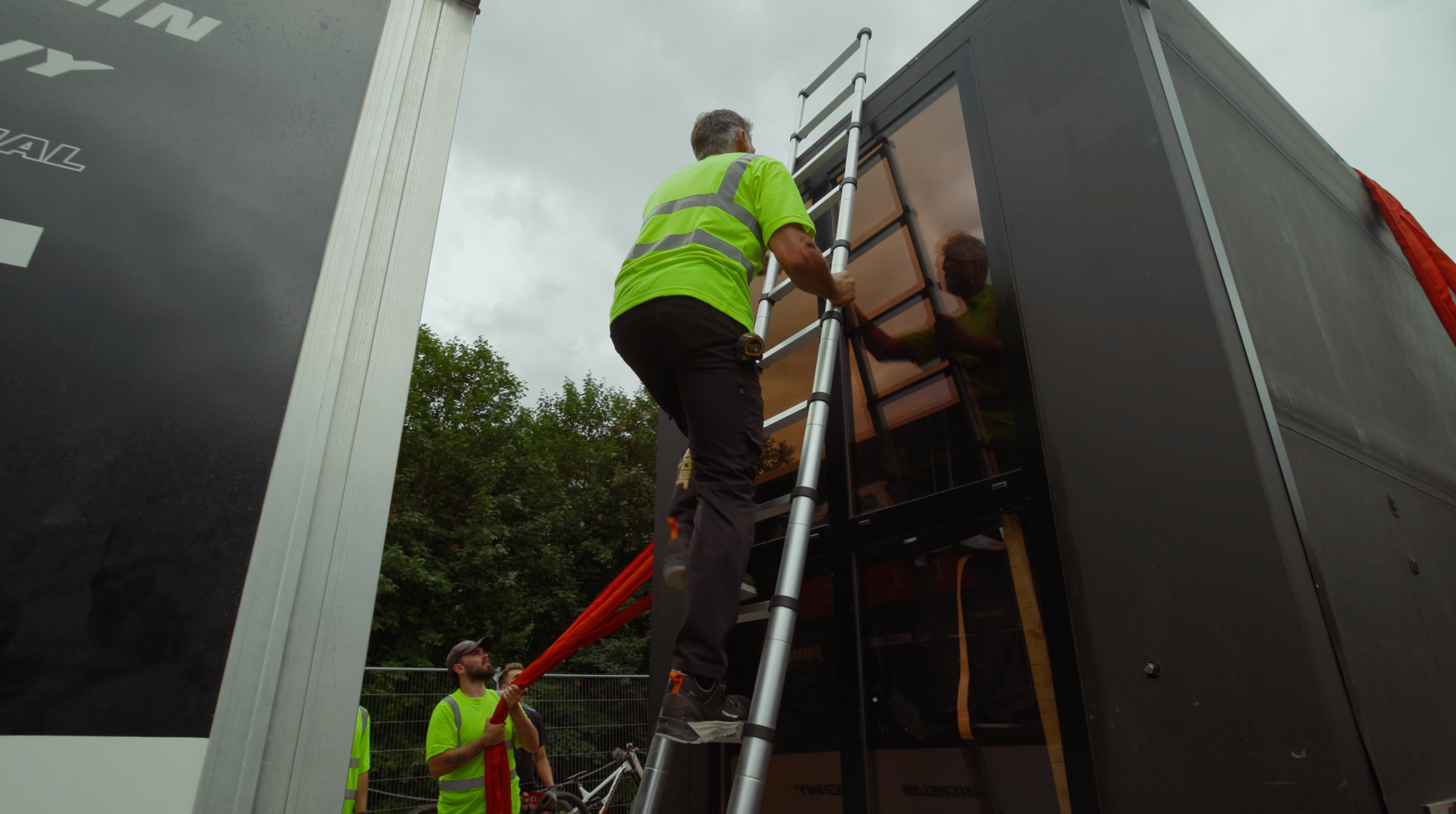
Looking at a finished paddock, you might think it's a major logistical exercise. However, following the construction, another aspect immediately emerges: the physical one.
They lift weights, carry materials, work while crouching or kneeling. They climb up and down structures and constantly move between trucks and containers, often on gravel or uneven surfaces.
And it needs to be done quickly.
The weather doesn't wait, and neither does the World Cup schedule.
It's precisely at this stage that BOA® enters history. Not on the shoe of the rider hurtling toward the finish line, as one might naturally imagine, but on the feet of the people building the place where that rider will work all weekend.
The MS-RACING team uses safety footwear Solid Gear Sonar WRP Low equipped with BOA® PerformFit™ Wrap.
Performance technology applied to work
The underlying concept is interesting because it brings together two apparently distant environments.
On one side, there's the athlete, for whom precision, control, and connection with the equipment are essential. On the other, there are mechanics and staff members who face long work days, constantly on the move and operating in conditions where stability and safety are equally important.
BOA® PerformFit™ Wrap uses independent panels that wrap around the foot, with the goal of keeping the heel stable and increasing the connection between foot and shoe.
So it's not simply a matter of replacing laces with a dial. The system works on the way the shoe wraps around the foot, allowing for precise and quick adjustment.
A detail that takes on a different meaning when the day doesn't last the length of a single heat, but many hours.
Then come the bicycles
At some point something changes.
The structures are assembled. The benches are ready. The tools are ordered. The spare parts are waiting in their boxes.
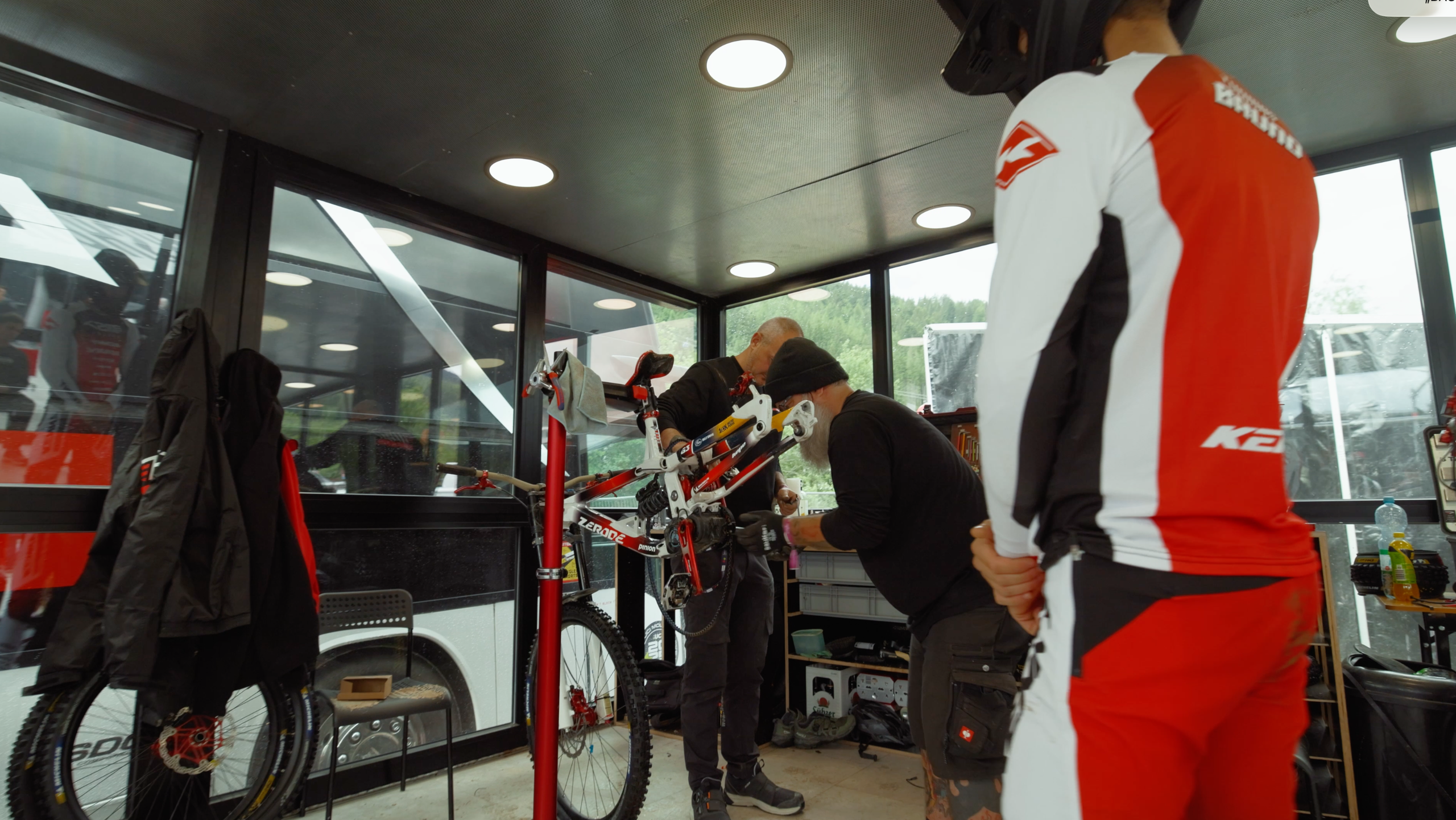
And finally the bicycles arrive.
From that moment on, the paddock stopped being a construction site and became what we all know: a race base.
The mechanics begin working on the setup, riders come in and out of the garage, and discussions begin about pressures, suspension, lines, and times. Attention gradually shifts toward the mountains.
The most visible part of the weekend can begin.
The race before the race
Perhaps this is the most fascinating aspect.
When we see a rider at the starting gate we tend to think that his race begins at that moment.
In reality, behind those few timed minutes there are days of work.
There are people who have driven trucks, unloaded containers, assembled structures, prepared workshops, organized hundreds of components and built an environment in which every action, during the weekend, can be as quick and efficient as possible.
The World Cup we see along the way is only the part that has emerged.
Underneath there are logistics, organization, hard work and dozens of people who rarely end up in front of the cameras.
Next time we enter a paddock we'll probably keep looking at the bikes straight away.
Hard to resist.
But maybe, before we get close to the latest prototype bike, we'll also take a quick look at everything around it.
Why Before building a performance, you need to build the place where that performance can take place.

