Mountain biking through Guadarrama, Brunete, Valmayor, El Escorial, and Sierra Oeste. A territory to explore and a passion that, for a few kilometers, brings a father and son together.
by Mingus Matera
The great thing is that you don't even have to take the car.
In Villanueva del Pardillo, you open the door, hop on your bike, and soon the asphalt is over. The dirt begins. A track, a path, some Holm oak, open fields and, almost always somewhere in front of you, the profile of the Sierra de Guadarrama.
My son is getting to know this area like this.
Pedaling.
We've done some of these tours together, others he's done. Then we return home, talking about where we've been, about a climb, a particularly beautiful trail, something we saw along the way. A name on the map leads to a search for a story, an old building becomes a question, one route suggests another.
Little by little the territory takes shape.
And I like to think that this is what the bicycle serves above all: to make the world big enough to still have something to discover and close enough to be able to start from your front door.
In one year, 59 laps were completed, covering approximately 1.920 kilometers and 32.000 meters of elevation gain. Almost all of them began here, in Villanueva del Pardillo. But looking at the map, what strikes me more than the numbers is the sheer number of different worlds within those kilometers.
Just choose a direction.
Towards the south: the memory of the battle
If you head south you go towards Villafranca del Castillo and Brunete.
It's a relatively easy ride, about thirty kilometers, and the landscape doesn't seem dramatic. You pedal along the Guadarrama, through fields and dirt roads, with that feeling of freedom that dirt roads offer when no one is passing by.
Then the Castillo de Aulencia appears.
It stands on a hill, at the confluence of the Aulencia and Guadarrama rivers. Looking at it, it's natural to wonder what it's doing there.
And so you discover that you are cycling inside one of the sites of the Battle of Brunete.
In July 1937, fierce fighting took place here. Villanueva del Pardillo, Quijorna, Villafranca del Castillo, Brunete: the names we read on the road signs today were then front lines. The signs of the fighting are still visible on the castle, and, continuing toward Brunete, small forts and trenches remain in the area.
It's one of the aspects that fascinates me most about cycling.
You don't just walk through a place. You have time to notice it.
In a car, you'd probably just pass by. On a bike, however, you see a building in the middle of a field, slow down, maybe even stop. And from that moment on, the landscape is never the same again.
Having a child by your side brings an added pleasure. It's not necessarily having to explain things to them. In fact, sometimes it's exactly the opposite. They've already traveled that path, they know where a trail leads, or they tell me what they've found further down the road.
And it's a curious and beautiful feeling.
Because there comes a time when children begin to build their own world geography. And when part of that geography happens to coincide with one of our passions, we have the privilege of being able to enter it.
Towards the West: The Water and the King
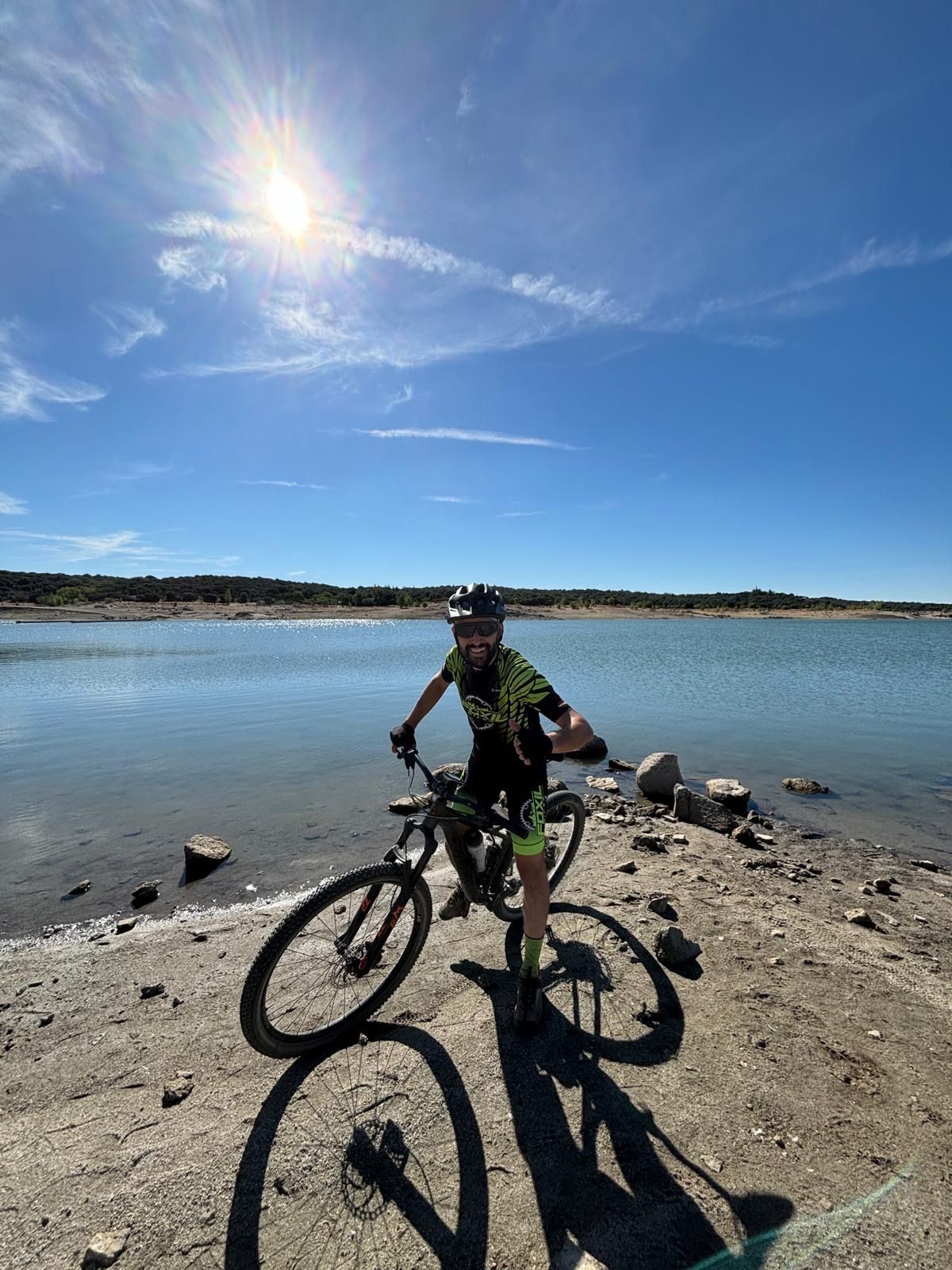
If we head west from home, however, water appears after a while.
Valmayor
The reservoir is enormous, the second largest in the Community of Madrid, and circling it means exploring more than 45 kilometers of trails, paths, and stretches along the shoreline.
Here the bicycle runs.
Then, perhaps, you stop to look at the water and discover that another landscape exists beneath its surface. There are old submerged roads and bridges, including the Puente del Tercio, along one of the ancient routes to San Lorenzo de El Escorial.
It is a thread that inevitably leads to Felipe II.
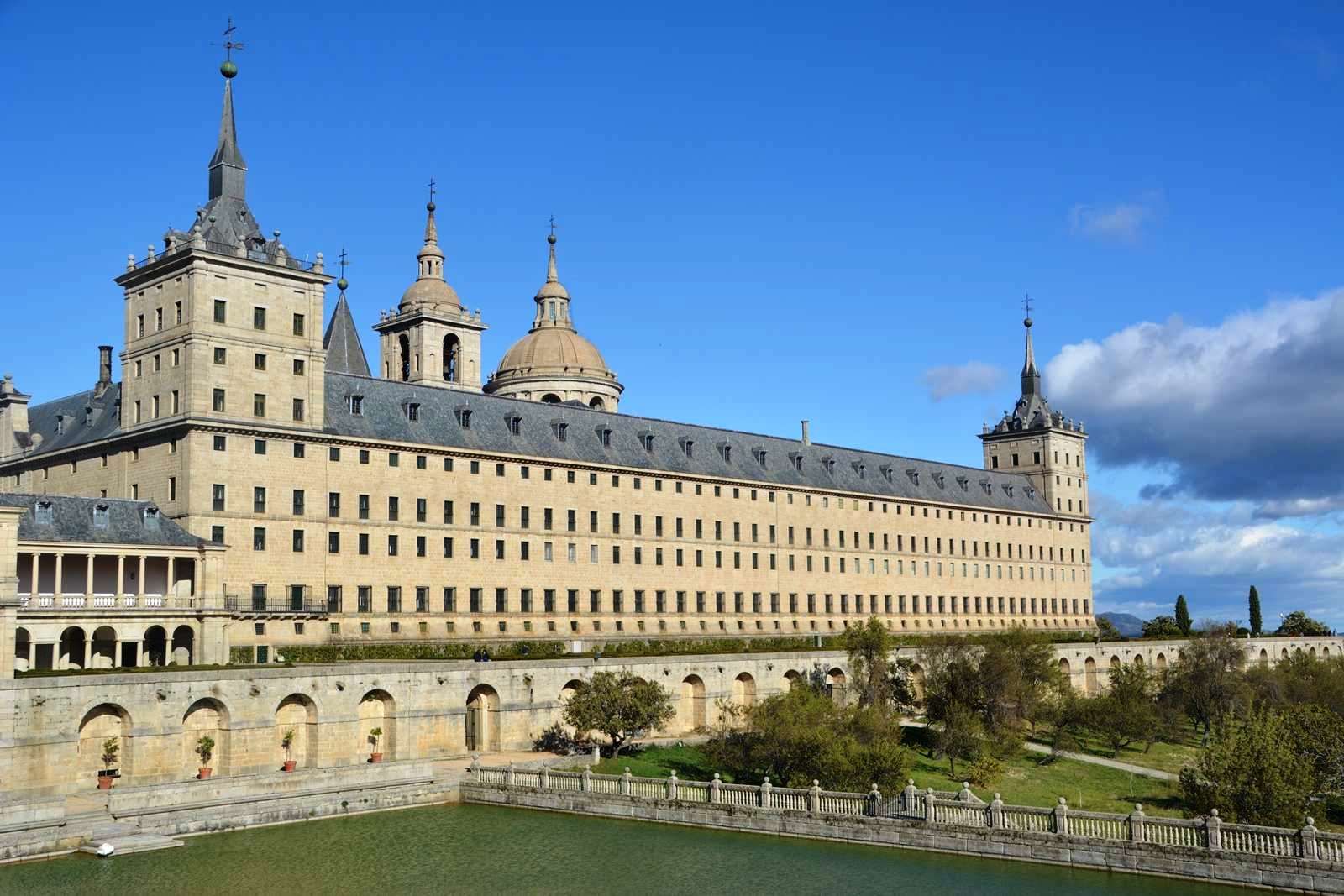
Centuries ago, people traveled through these parts toward the Monastery of El Escorial. Today, we follow part of those directions with wide tires, helmets, water bottles, and GPS tracks.
The means change, but something very human remains: the curiosity to know where a road leads.
And that road, continuing to climb, can take us even further.
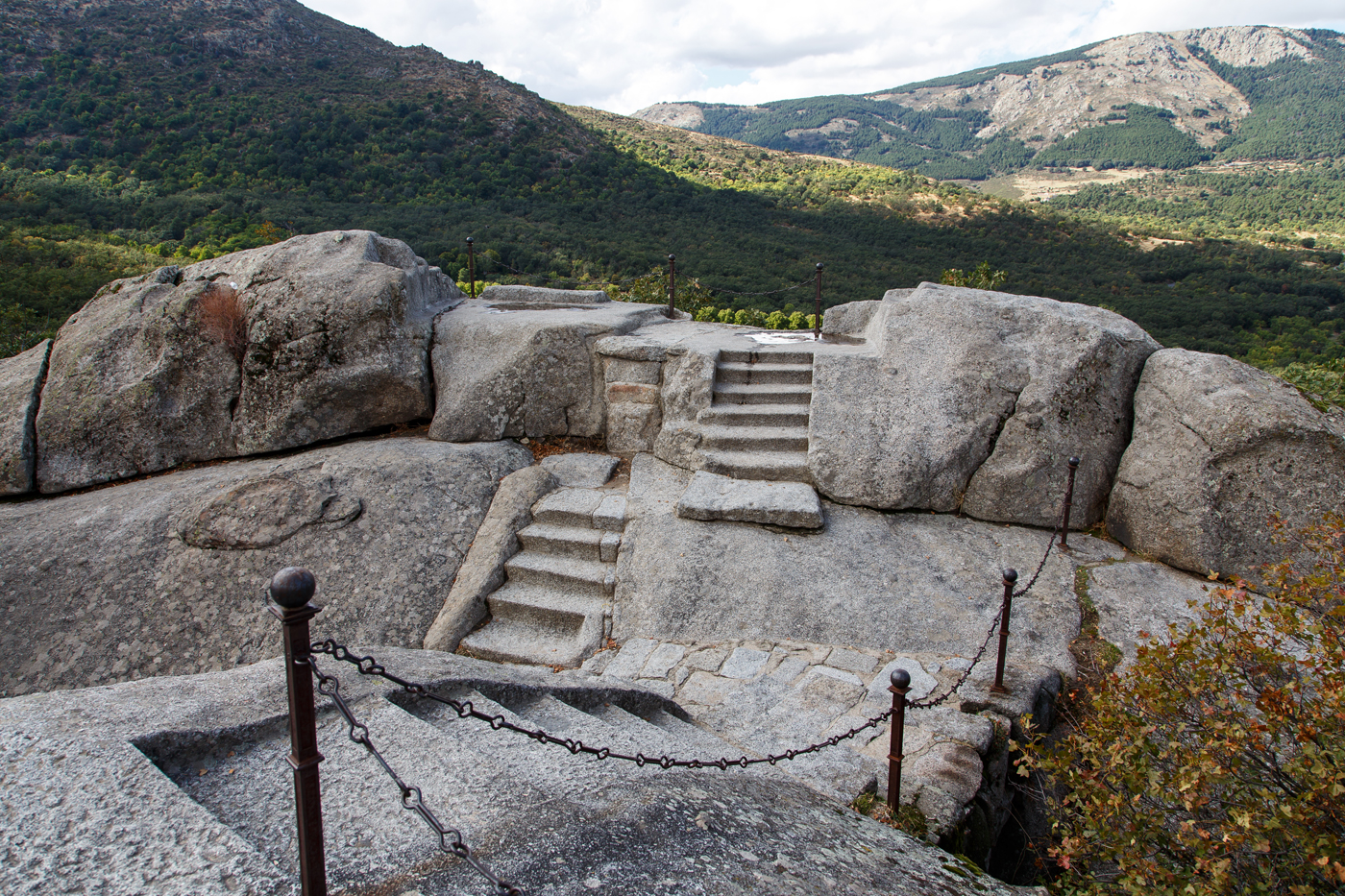
The Silla of Philip II
From Valmayor you go up towards El Escorial, cross the Bosque de la Herrería and reach the Silla de Felipe II.
One of the tours in these parts is 65 kilometers long and has an altitude difference of about 900 meters.
The story everyone tells is that the king sat on those granite rocks to observe the construction site of the Monastery.
Except maybe that's not true.
Some studies suggest that this place may be much older, perhaps a ritual space linked to the Vettones.
And here's another thing I like about these tours: you set out thinking you're going for a ride, and you come back with a story you didn't know. Or, even better, with a doubt.
Sometimes my son tells me what he's discovered. Other times we search together.
The bike, meanwhile, is there.
The road that wasn't Roman
It also happens when going towards Zarzalejo and Las Machotas.
There is a pavement there that practically everyone calls Roman roadThe name is so convincing that, when you walk over it, it's natural to imagine that those stones have been there for two thousand years.
But no.
Documents state that the road was built to transport stone from the La Alberquilla quarries to the Monastery, at the behest of Philip II. The so-called "Roman bridge" is also thought to be much more recent.
Sixty-six kilometers and almost 1.200 meters of altitude difference to discover, among other things, that a Roman road was not Roman.
Not bad for a day on the bike.
Then you return along the ancient pastoral paths, wide and fast, and for a while you stop thinking about history. You just pedal.
This is also what sharing a passion makes possible.
You don't necessarily have to talk.
There are moments when we chat and others when everyone proceeds at their own pace. Then we meet up again. A break, something to eat, a water bottle, a joke, and off we go again.
I don't know if it's necessary to give these things a name.
I know we spent time together.
Sierra Oeste deep, up to the Moon
Continuing further west, beyond Valdemorillo, the landscape changes again.
The Sierra Oeste is more rugged. The climbs become harder, rocks arrive and descents between the oaksOne of the loops towards Fresnedillas de la Oliva combines about 58 kilometers and 1.100 meters of altitude difference.
But the most surprising thing isn't the climbs.
It's the Moon.
Because at a certain point you arrive in a small town in the Sierra Madrid and discover that a station linked to the Apollo missions operated here from 1967 to 1985. Fresnedillas also received communications on that night of July 20, 1969, when man set foot on the Moon.
Today there is a Lunar Museum in the village.
And not far away are two Civil War forts.
This closeness seems almost incredible to me.
War and the Moon.
Two forts and the Apollo program.
All within the space of a few kilometers.
Perhaps this is the deepest meaning of exploration: not necessarily going far, but learning to look at what's around us with enough curiosity to let ourselves be surprised.
And the bicycle, in this regard, is an almost perfect means. Fast enough to take us far. Slow enough to allow us to see.
The great classic: from the village to the ridge
From Villanueva del Pardillo the Sierra is almost always there.
You see it in the distance, and if you keep pedaling around here, sooner or later a question inevitably arises: what if we could get up there?
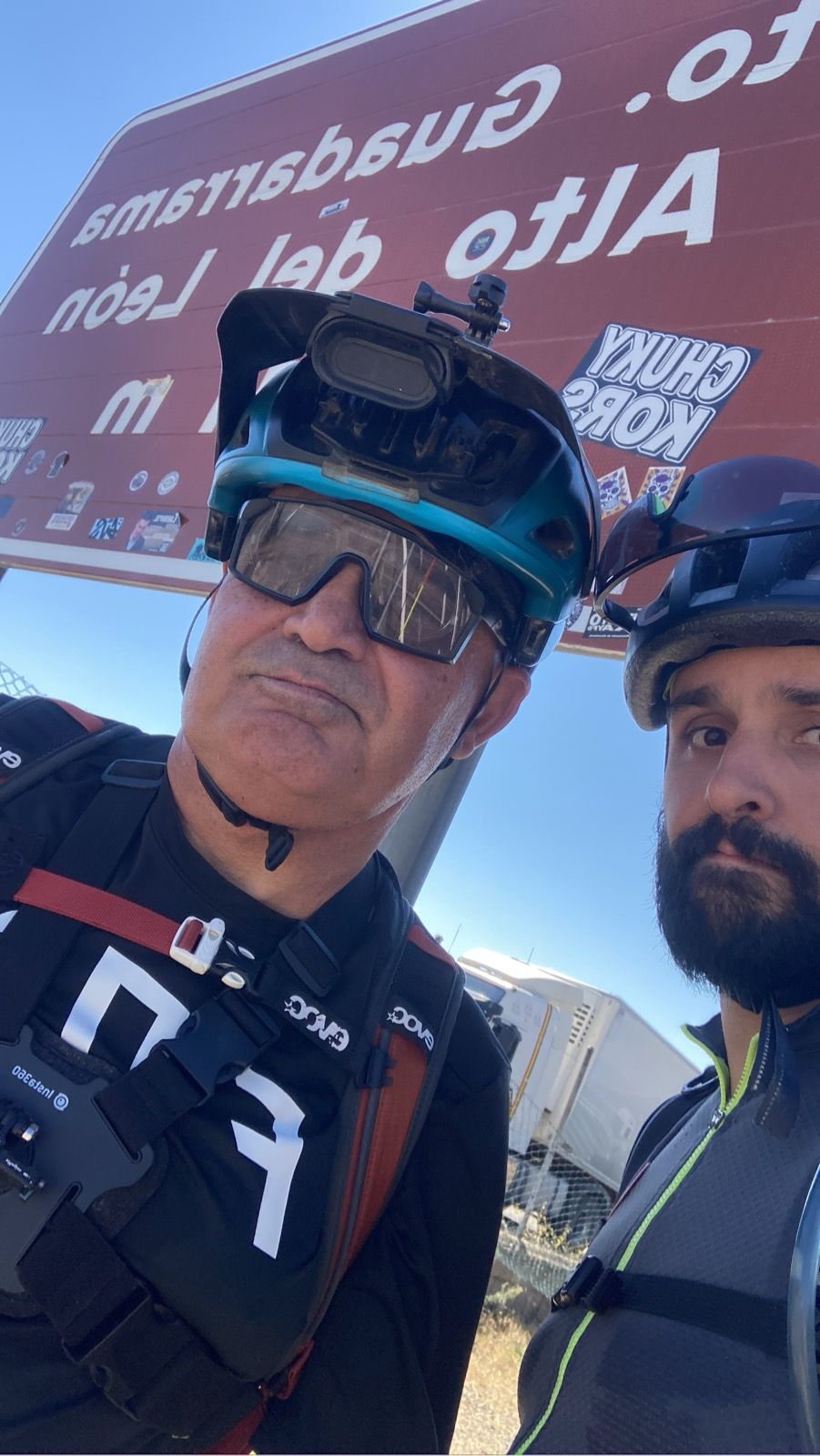
One of the answers is a 92-kilometer ride with over 1.750 meters of elevation gain.
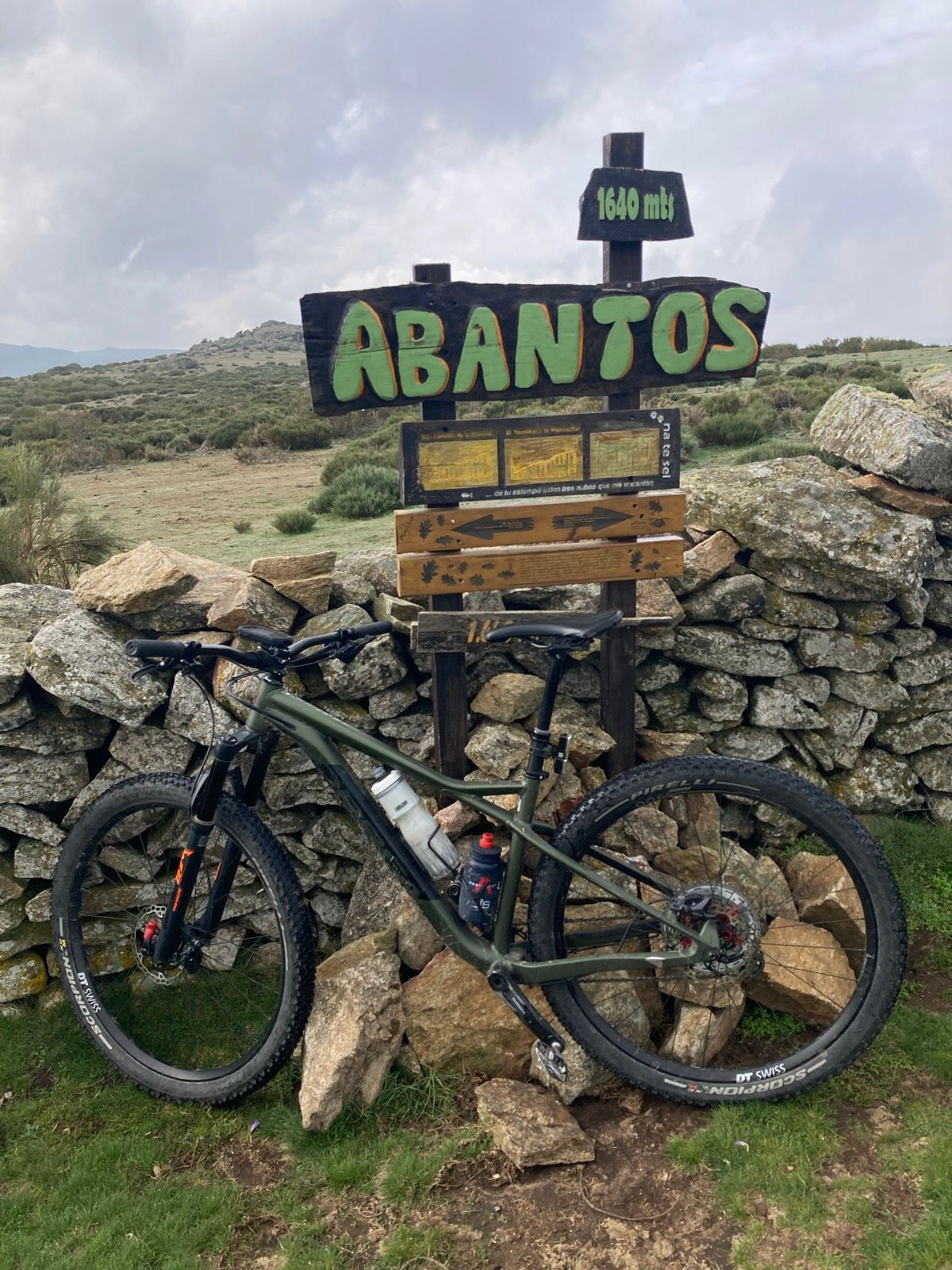
We start from the village, climb towards La Jarosa and Alto del León, then continue along the ridge towards Abantos and finally descend towards El Escorial.
At that point it doesn't seem like a lap in the park anymore.
It feels like a journey.
At Alto del León, we find the large stone lion that commemorates the opening of the pass in 1749, under Fernando VI. A little further on, bunkers and trenches from the Civil War reappear. At Collado de la Mina, the name preserves the memory of a tungsten mine opened after the war.
And finally comes Abantos.
In 1999, a fire burned 425 hectares of this mountain. Today, we cycle through the forest again, above El Escorial, with the Monastery below and the entire plain opening up before us.
Then comes the time to go down.
And sometimes it's better for words to disappear.
What remains is the trail, the sound of the tires, the air, the concentration, and that basic feeling we knew so well as children: riding a bike is simply beautiful.
The home playground
However, it is not always necessary to reach the ridge.
Between Galapagar and Colmenarejo, there are much closer routes. Cerro del Madroñal, Casa de la Patata, trails through the rocks, short climbs, and descents. Forty kilometers can easily become a thousand meters of elevation gain.
It's the territory you learn to know by returning.
The first time you take a path. The second time you discover a detour. The third time you realize that detour connects to another trail you'd taken months earlier.
And the map in my head grows.
My son's is probably growing faster than mine right now.
And rightly so.
He travels this land, discovers it, returns and tells me about it. Sometimes the next time we go there together. Other times, that place simply remains within his story.
But somehow it ends up on my map too.
A complete territory
Perhaps this is the thing that remains with me from all these journeys.
Children grow up and inevitably begin to go their own way. That's what they're meant to do. They discover interests, places, and passions that are unique to them.
We can only hope that, every now and then, some of those roads still allow us to pedal together.
It doesn't even matter who discovered it first.
It doesn't matter who's in front.
And it probably doesn't even matter whether the bike is powered or assisted. The bike is the means, not the end. It's an extraordinarily simple way to get out, cross a territory, get somewhere under your own steam, and experience something along the way.
On these journeys we found rivers and mountains, castles and trenches, roads that were not Roman, forests, lakes, kings, wars and even the Moon.
But the most precious thing was not marked on the map.
It was being able to share part of the journey.
Sometimes I was the one pedaling next to my son.
Other times it was him who came back and told me where he had arrived, what he had seen, which path he had taken.
And perhaps this is one of the most beautiful gifts a shared passion between a father and son can give: creating a common ground without forcing either of them to always follow the same path.
We can leave together.
You can each go your own way.
You might find yourself in front of a climb, at home in front of a map or simply in the story of a ride.
Because exploring together doesn't necessarily mean always covering the same miles.
It means still having something to tell each other when you get home.
And perhaps, listening to someone else's story, you'll already feel like starting over.