
At the same time, the growing interest in 32-inch wheels could push some enthusiasts to postpone purchasing current 29" MTBs. Added to this is another potential risk: confusing strong customer interest with real demand, increasing orders and sales forecasts beyond the market's actual capacity. This isn't a prediction of a new MTB crisis, but a question worth asking, given what has happened in recent years, before warehouses fill up again.
At Misano, I didn't gather anything certain. I gathered a feeling. And after what the industry has experienced in recent years, perhaps it's worth listening to before it becomes a problem.
Misano is a time for innovations, presentations, and the bikes that will hit the shops in the coming months. But for those who write about this sector, it's also one of the few times of the year when companies, distributors, retailers, and sales managers all meet in the same place.
It's there, between a stand and a coffee, that the most interesting conversations begin.
Not about which bike is faster.
But how the market really is.
An enthusiasm that coexists with great caution
If I had to sum up the feeling I felt at the fair in just one word, I probably wouldn't be able to.
There's enthusiasm. A lot.
But beneath that enthusiasm, one can also sense a caution that we would not have found so widespread a few years ago.
Many are still reeling from the post-Covid crisis. They've seen solid companies downsize, warehouses become a huge burden, and margins evaporate due to increasingly aggressive discounts.
This is why a question inevitably comes up again today.
What if we're starting to inflate another bubble?
The first ingredient is called Avinox
Everyone is looking for it.
Everyone wants it.
And it's normal that it is so.
Avinox probably represents the most important innovation of the moment in the world of e-MTB: more power, compact batteries, lighter bikes and an experience that has quickly convinced the market.
The problem, however, is not Avinox.
The problem is what he leaves behind.
Many brands hadn't yet fully phased out the 2023 and 2024 models when this new generation of engines arrived. So a bike that until yesterday was simply "last year's model" now risks being perceived as having an old engine.
And perception, in the market, weighs almost as much as reality.
The question that changes everything
The enthusiast enters the shop and sees two bikes of the same brand.
One is obvious.
The other one has Avinox.
The question arises almost automatically:
Why should I buy the old one?
From now on the problem is no longer selling the new.
It's being able to sell the old without destroying margins.
Interest and demand are not the same thing
But let's try to look at this dynamic from the other side of the counter. It's a mechanism described to me in Misano by an importer with over thirty years of experience in the sector, and which, in its simplicity, helps us understand where a distortion might arise.
Let's take an example with deliberately simple numbers. Let's imagine that there are 15 people actually interested in buying a new e-MTB And that, before making a decision, everyone visits three stores in the same area. This is perfectly normal behavior when you have several thousand euros to spend.
Those However, 15 customers generate 45 business contactsIf that surge in interest leads the three retailers to even moderately raise their forecasts, the total orders could significantly exceed final demand.
And this is where the example becomes interesting, because it's pointless to imagine retailers suddenly losing their sense of proportion. Suppose each of them is used to selling five bikes in that price range and, seeing a sharp increase in demand, decides to order eight instead of five. A decision that, taken individually, doesn't seem risky at all.
Three shops for eight bikes mean, however, 24 bicycles ordered from 15 real potential customers.
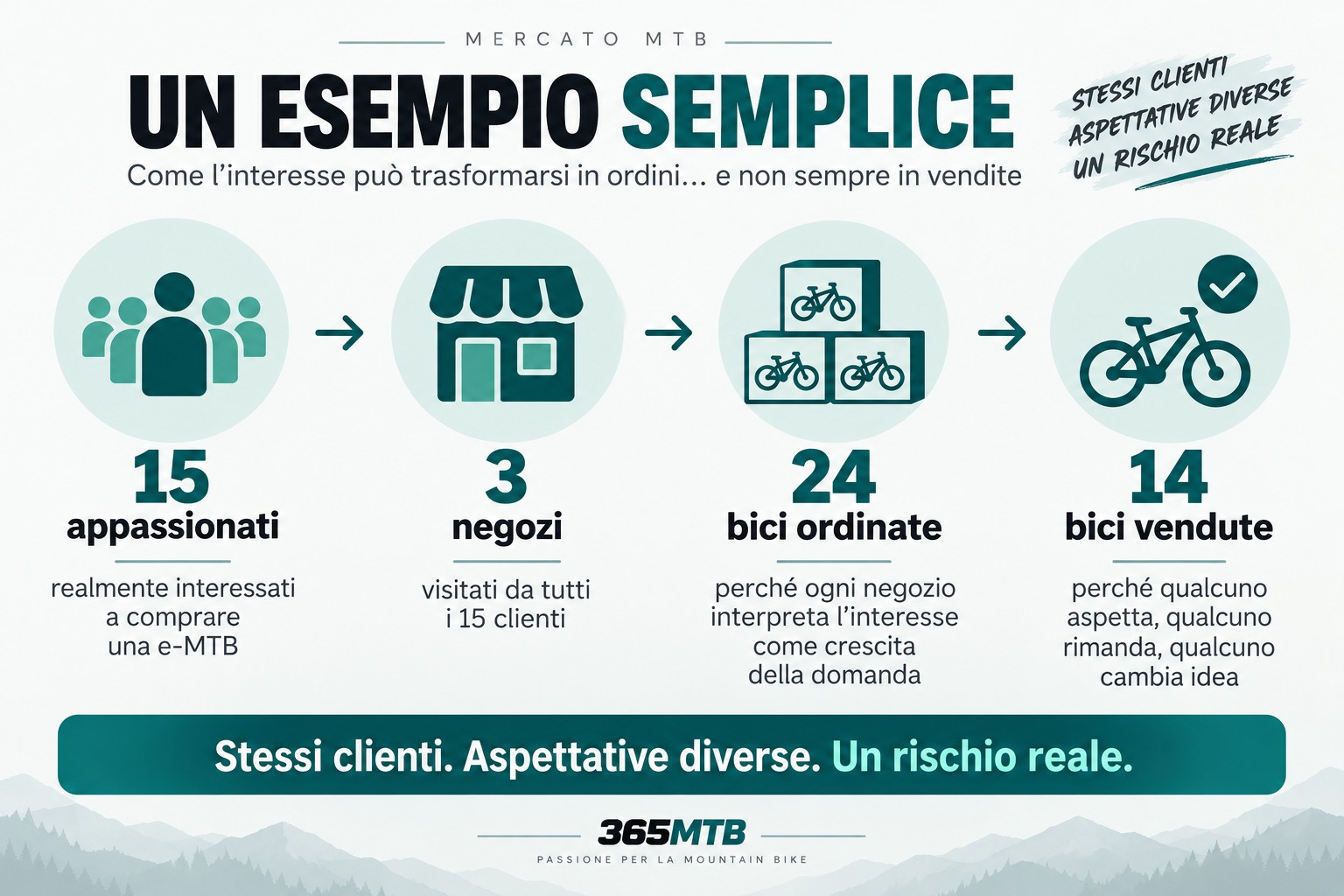
The numbers are deliberately invented.
The mechanism, however, is very real.
The same customer can be counted three times along the supply chain, fueling expectations that the final market may not confirm.
And while everyone is looking at Avinox…
…another variable appears on the horizon.
The 32-inch wheels.
Until a few months ago, they seemed like just a rumor. At Misano, however, they began to take on much more concrete shape.
Here, however, I would like to avoid the usual discussion.
I'm not interested in deciding today whether a 32″ is better than a 29″.
I'm interested in understanding what happens before it even hits the stores.
The real question is not technical
If the customer thinks that in six months their brand will be introducing a 32″, what will they do today?
Will he still buy a 29″?
Are you looking for a significant discount?
Or will he wait?
All it takes is for a portion of enthusiasts to choose the latter option for the market to slow down just as companies are investing in the next generation.
A bigger wheel changes the entire supply chain
When we talk about 32″ we’re not just talking about a larger rim.
We're talking about new frames, new forks, new tires, new molds, new investments, and new warehouses.
A supply chain still trying to regain its balance could find itself, once again, having to manage another change in standards.
And the history of MTB teaches us that every technical revolution also brings with it a commercial revolution.
The post-Covid lesson
The previous crisis didn't happen because the market was doing badly.
It arrived because, at a certain point, much more had been produced than the market was actually able to absorb.
This is the fundamental difference.
Growth is not the problem.
The problem arises when enthusiasm, orders and expectations start to outpace actual customers.
A question, not a sentence
I don't know if there really is a new bubble.
And it would be incorrect to write it as if it were a prediction.
However, I know that, speaking with those who experience this sector every day, some signals have come back surprisingly familiar: warehouses that still weigh heavily, innovations that accelerate commercial obsolescence, requests that could be interpreted as consolidated demand, and a new standard ready to reshuffle the cards once again.
For this reason, leaving Misano, I was left with one feeling above all.
Bubble scent.
Maybe it's just an impression.
But if the sector has truly learned anything from recent years, perhaps the right time to discuss it is now, when we are still in the realm of questions, not emergencies.