MTB athletic preparation: how to organize training sessions, develop endurance and strength, use heart rate and watts, and build an effective season, from XC to enduro.
Mountain bike training isn't just about getting out more often, covering more miles, or trying to beat your time on every climb. It's about building, over time, the physical and technical skills needed to tackle trails more efficiently, safely, and with greater enjoyment.
That you practice cross country (XC), trail riding or enduro, a good one MTB athletic training It can make a difference. But getting results isn't enough to simply rack up hours in the saddle: you need to understand what to train for, when to do it, and above all, how to fit the workout into your life.
Because the first principle of an effective program is simple: There is no absolute best workout, there is the best one for your characteristics, your goals and the time you can actually dedicate to it.
1. The four pillars of MTB athletic preparation
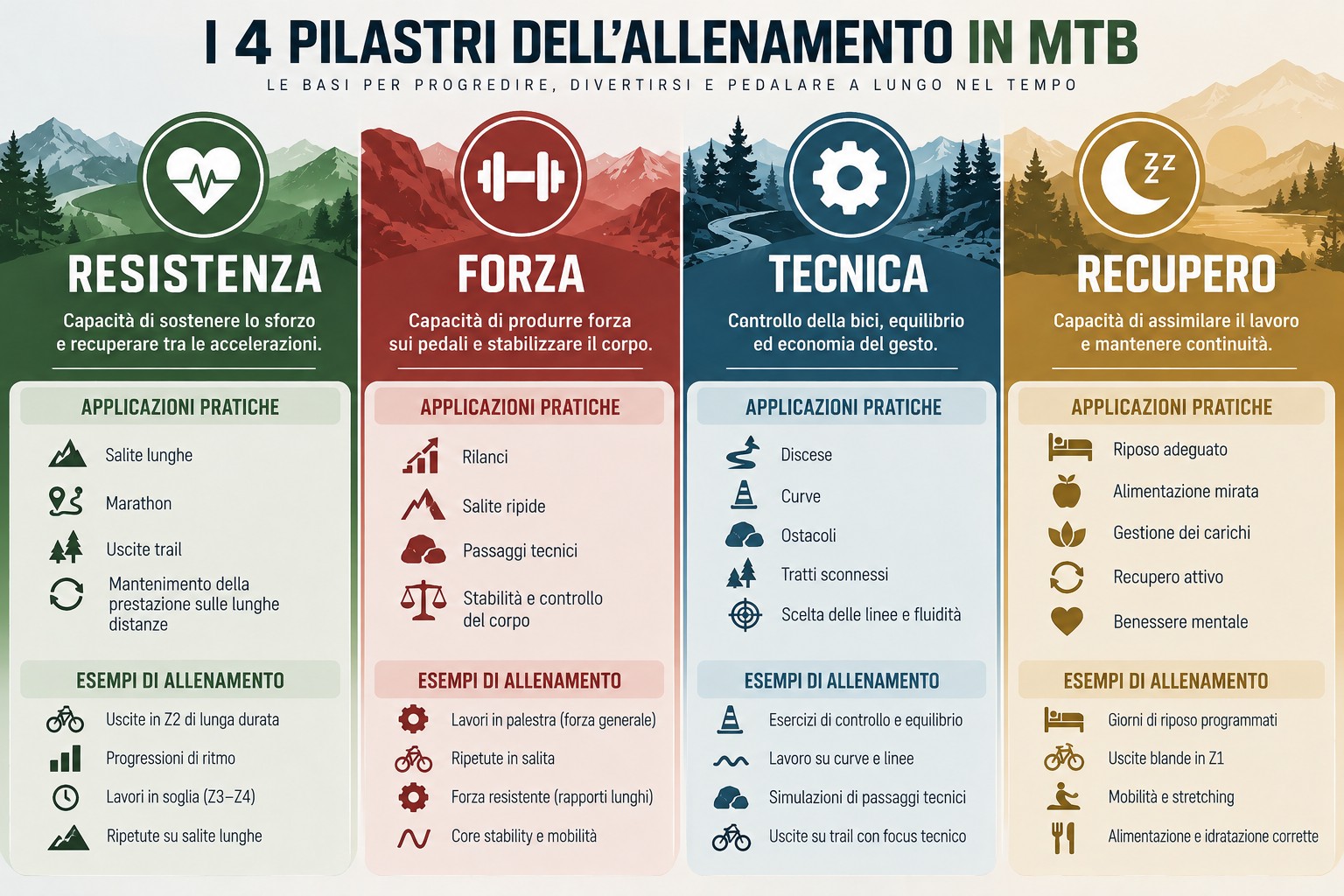
Mountain biking performance depends on the interaction of multiple skills. Focusing exclusively on endurance, neglecting strength, technique, and recovery, is incomplete preparation.
These four pillars must be developed in different proportions depending on the discipline.
In 'XC Aerobic power, the ability to repeat intense efforts and pedalling efficiency are particularly important.
In between riding Good general endurance, functional strength, and the ability to maintain clarity and control after several hours are required.
In 'enduro Endurance strength, core stability, the ability to absorb stress and the repetition of challenging descents become fundamental, without neglecting the aerobic condition necessary to tackle transfers.
2. Before training, evaluate where you are starting from
One of the most common mistakes is copying the program of a more trained athlete, without considering your own level.
Before setting up any preparation it is useful to make an initial assessment.
Checklist: Are you ready to build your program?
- I know the number of hours I can dedicate to training each week.
- I know how many outings I can do consistently.
- I assessed my current level of endurance and strength.
- I know my main technical limitations.
- I have identified a realistic goal for the season.
- I know what tools I have available to track my workouts.
- I considered work, family, recovery, and other commitments.
- I have planned how to adapt the program during the busiest weeks.
If some answers are negative, it doesn't mean you can't get started. It simply means you need to better define your starting point first.
"Tell me what you can do, not what you want to do."
When it comes to programming, the first question shouldn't be, "How much do you want to train?"
It should be: "How much time can you actually dedicate to training, on a regular basis?"
The distinction is fundamental.
A cyclist might want to do five workouts a week, but between work, family, and unexpected events, they can only manage three. In this case, an extremely detailed five-day program risks becoming frustrating and ineffective.
It's much better to build a plan of three well-organized, truly sustainable sessions.
This reasoning applies especially to amateurs. For a professional, training is a priority around which they organize a large part of their day. For those who ride MTB in their free time, their schedule needs to adapt to their life, not necessarily the other way around.
Continuity is worth more than perfection. A simple program, followed for months, can produce better results than a sophisticated one followed only intermittently.
3. Training planning: think about a year, not a week
Effective preparation does not arise from the random addition of individual outings.
It is the result of a program that distributes loads, intensity and recoveries over time.
Traditionally, three levels are distinguished:
- Macrocycle: long-term planning, generally referring to the season or year.
- Mesocycle: block of a few weeks dedicated to specific objectives.
- Microcycle: organization of individual days, often on a weekly basis.
Annual planning, or periodization, allows you to progressively develop the necessary qualities and arrive at the main events in adequate condition.
The five phases of MTB preparation
1. Transition period: recovering after the season
At the end of the competitive season, or after a long period of intense activity, it is useful to plan a transition phase.
The goal is not to deliberately lose physical condition, but to recover from accumulated fatigue.
You can reduce volume and intensity, practice other sports, focus on mobility and continue cycling without any particular performance constraints.
The duration depends on the previous load and the athlete's condition.
2. General preparation: building the foundation
This is the phase in which the foundations of athletic condition are developed.
The work mainly includes aerobic endurance, general strength, mobility, stability and technique improvement.
Controlled intensity outings play an important role, along with strength exercises and a progressive increase in overall load.
The goal is to create the conditions to tolerate the more demanding work of the coming months.
3. Specific preparation: train the qualities necessary for the discipline
In this phase, training sessions become progressively closer to the demands of the discipline being practiced.
For an XC biker, high intensity intervals, restarts and hill work can increase.
For marathon runners, the ability to sustain prolonged efforts and energy management become important.
In trail and enduro, specific strength endurance work, technical sequences and descent repetitions can be introduced.
4. Pre-competitive period: getting closer to the goals
Pre-competitive preparation serves to transform the skills built into performance.
Training sessions become more specific and may include race simulations, event-like courses, and effort management tests.
As the main event approaches, a targeted reduction in load can aid recovery while maintaining the adaptations achieved.
5. Competitive period: expressing and maintaining the condition
During the racing season, the goal is not to continuously increase the load, but to find a balance between competing, maintaining physical quality, and recovery.
Not all races necessarily need to be approached as primary objectives.
Some can become opportunities for preparation, while others represent the appointments on which to focus work.
An example of annual distribution
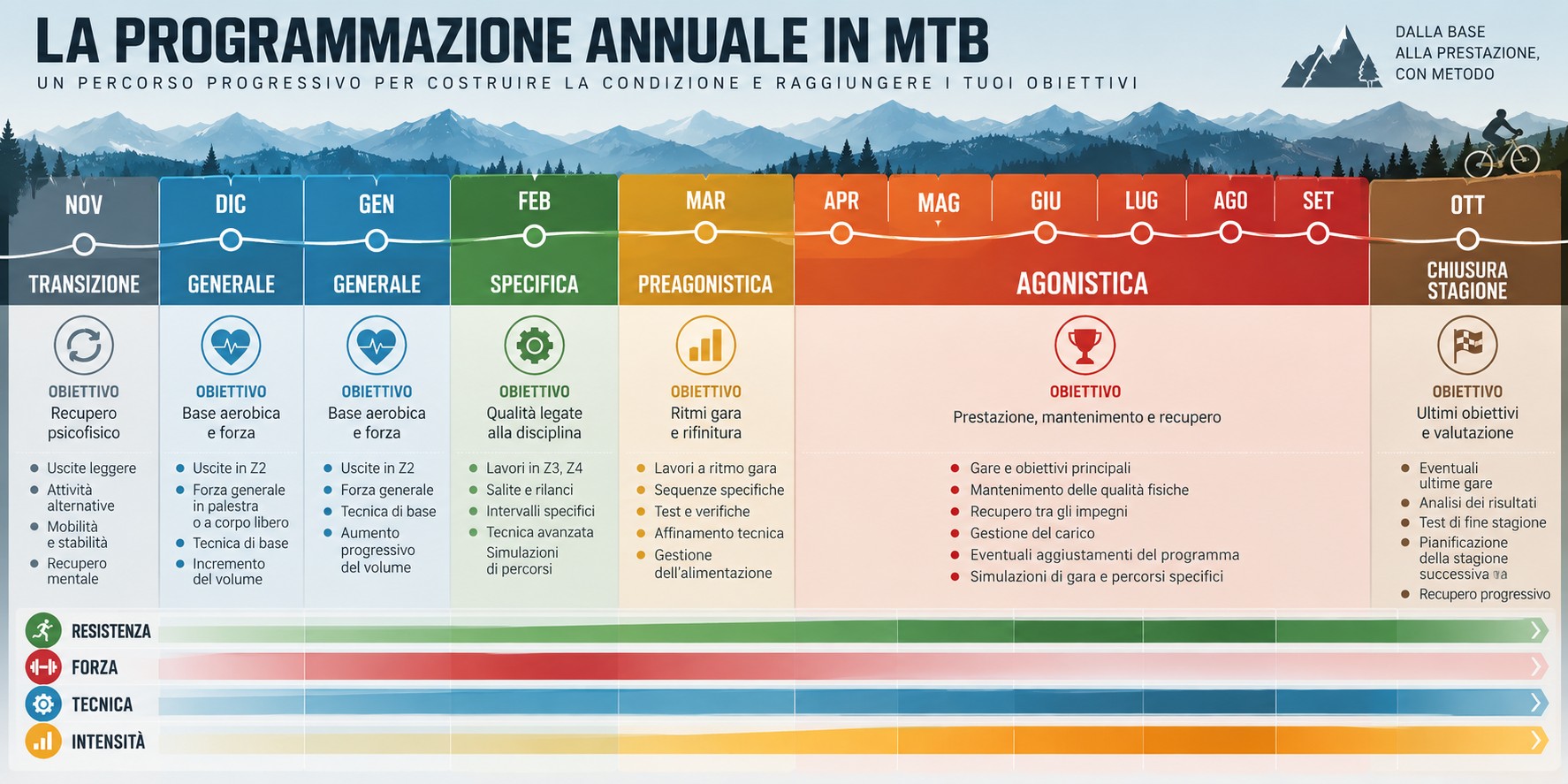
This is just a rough guide: the calendar changes depending on the races, weather, discipline, and personal commitments. Phases may overlap and repeat throughout the year.
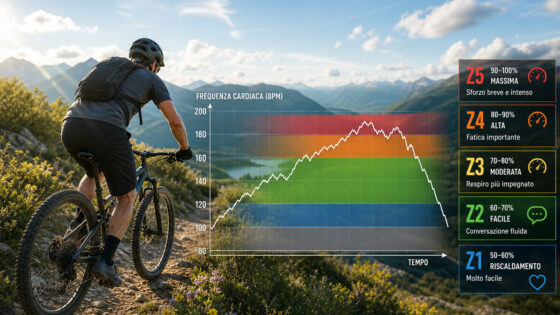
4. Training zones: from heart rate to watts
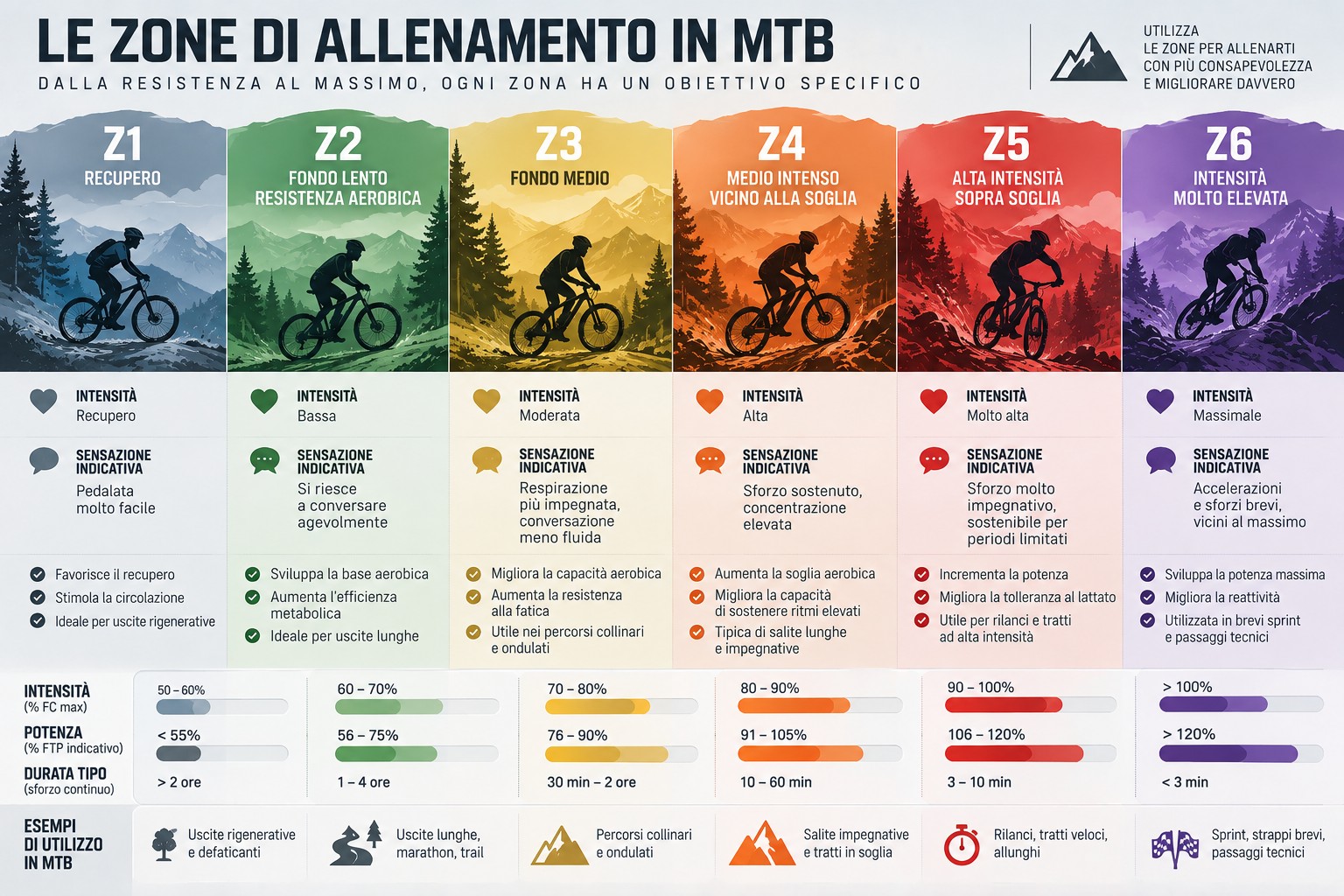
To train wisely it is necessary to distinguish the different intensities of effort.
At one time we mainly talked about slow bottom, medium bottom, medium intense, threshold and above threshold.
Training zones are often used today, indicated by the letter Z followed by a number.
But be careful: there is no single universal system of zonesSome models have five zones, others six or seven. Furthermore, heart rate zones do not automatically match power zones.
To make the concept clearer, we can use a six-zone descriptive classification.
This table serves an introductory purpose. The precise definitions and boundaries depend on the chosen model and individual values.
Heart rate: how our body responds
Heart rate represents the body's response to effort.
It is a useful tool, especially for aerobic training, but it has some limitations.
Heart rate can be affected by temperature, dehydration, fatigue, stress, caffeine, and environmental conditions. It also reacts somewhat delayed to changes in intensity.
For this reason, during a sprint lasting a few seconds, heart rate does not faithfully represent instantaneous intensity.
Power: the work expressed on the pedals
The power meter measures the watts developed while pedaling.
Compared to heart rate, power allows you to immediately observe variations in mechanical effort.
It is especially useful for managing intervals and controlling the intensity of workouts.
A frequently used parameter is the FTP (Functional Threshold Power), a working estimate of the power an athlete can sustain for a prolonged effort near their functional threshold.
FTP is used to set different power zones, but it does not necessarily coincide with the physiological threshold measured in the laboratory.
Heart rate and watts: two complementary pieces of information
Let's imagine tackling a climb at 220 watts.
On a cool day and after a good recovery, your heart rate might stabilize at 145 beats per minute.
On a very hot day, or after a tiring week, the same mechanical effort may require a significantly higher heart rate.
The wattage value describes the power output; heart rate helps understand how the body is responding.
Using both, along with perceived effort, provides a more complete reading of your workout.
5. The tests: identifying the reference values
Training zones should not be set based on generic formulas alone.
Calculations like 220 minus your age can provide rough estimates of your maximum heart rate, but they have large margins of individual error.
To personalize the preparation it is preferable to use appropriate tests.
Field tests
Among the most common possibilities we find:
- 20-minute FTP test: Used to estimate reference power, applying a standardized protocol. The classic method uses 95% of the 20-minute average power, but it is not an exact measurement that is equally valid for everyone.
- Ramp test: incremental test, often performed on rollers, from which some systems estimate the FTP.
- Threshold heart rate test: test performed according to a defined protocol, useful for estimating an individual cardiac reference.
- Repeatable hill or route test: allows you to compare performances obtained over time in conditions that are as similar as possible.
Lab test
A functional assessment with gas exchange analysis and, when applicable, lactate measurement can help identify the athlete's physiological thresholds and aerobic characteristics.
It is a particularly interesting solution for those who want more precise preparation.
Maximal or very intense tests require adequate preparation and, in the presence of symptoms, medical conditions, or risk factors, a preventive health evaluation.
When to repeat the tests?
There is no need to test yourself continuously.
A check at the beginning of training, one during the development phase and further checks when the condition changes significantly can be sufficient for many amateurs.
The important thing is to use comparable protocols and update references when necessary.
7. Useful tools for MTB training
Technology today allows us to monitor numerous parameters, but not all tools are essential.
Heart rate monitor. A reliable chest strap is a great starting point for monitoring your cardiac response and managing your resistance training.
GPS cycle computer. Allows you to record duration, route, elevation gain, heart rate and, when available, power.
Power meter. Useful for those who want to control the intensity of their workouts more precisely, especially in structured workouts.
Rollers and smart trainers. They allow you to carry out controlled sessions even when the weather or available time makes it difficult to go out.
Analytics platforms. Software and apps like Garmin Connect, TrainingPeaks, Intervals.icu, and Strava can help you record your activities and monitor your load evolution.
Training diary. Even a simple notebook can be invaluable for recording sensations, sleep quality, tiredness, and results.
A good program doesn't necessarily require expensive tools. It requires, above all, method, observation skills, and consistency.
8. How to Know if You're Really Improving
One of the most common mistakes is to use every exit as a test.
Constantly chasing the fastest time on a climb or chasing every segment can lead to accumulated fatigue without leaving room for adaptation.
Progress can be assessed through more significant indicators:
- Being able to sustain a higher power output at the same heart rate, under comparable conditions.
- Tackle a familiar climb with less perception of effort.
- Maintain good technique even in the final stages of the exit.
- Recover better between demanding workouts.
- Complete routes that were previously very tiring with greater ease.
- Improve results in repeated tests with the same protocol.
It's important to observe trends over the weeks, not to interpret every single workout as a judgment on your condition.
Recovery should also be monitored: persistent fatigue, worsening sleep, irritability, and a prolonged decline in performance may indicate the need to reduce the load.
9. What is the first mistake of those who start training seriously?
The first mistake is to confuse training seriously with training hard all the time.
Many bikers, when they decide to follow a program, simultaneously increase the frequency of their rides, duration and intensity.
The result can be a rapid accumulation of fatigue, without commensurate improvement.
Training seriously, on the other hand, means giving a purpose to each session.
There are days when you need to work at high intensity, others when you need to develop aerobic endurance, and still others when the best training is recovery.
The quality of a program is not measured by how tired you get home, but by its ability to produce positive adaptations over time.