365 MTB's newest contributor takes us behind the scenes of professional trail building. From planning to permits, from local knowledge to sustainability: what it really takes to turn an idea into a trail.
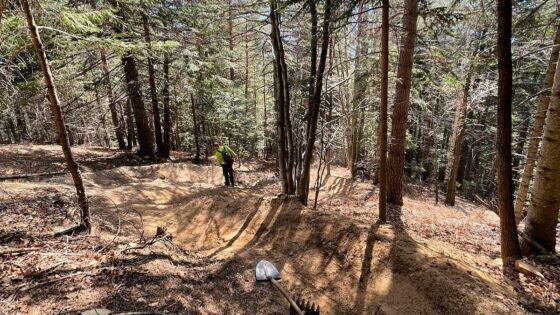
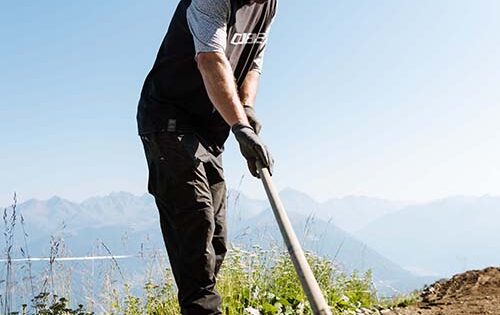
When it comes to trail building, the first image that comes to mind is almost always the same: someone in the woods with a shovel in hand, intent on shaping a curve, fixing a jump or carving out a path on a slope.
It's certainly part of our job. But it's only part of it.
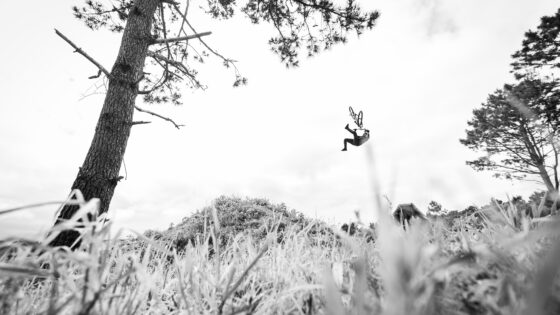
Over the years, I've had the opportunity to work in a wide variety of settings. From the trails of Bardonecchia, where construction is strongly geared towards bike parks, with carefully crafted lines and well-defined structures, to the more natural and enduro-oriented trails of the Piana di Vigezzo. I've also worked on the staff involved in the creation of the Olympic Big Air and in organizing sporting events, including an Italian Enduro Cup final and a stage of the Swiss Enduro Cup.
Different experiences, which taught me one thing above all: There is no single way to build a trail, but there is a professional way to approach the job.
And this way begins long before entering the forest with the tools.
The first job is to understand where we are
One of the questions I get most often concerns permits. How do you get permission to build a trail? How do you convince a municipality, agency, or landowner to support a project?
The answer is that there's no magic formula. There are no secrets that guarantee approval for a particular course of action in any situation.
However, there is a working method that allows you to make a project more credible, interesting and concretely feasible.
The first thing I do when I'm faced with the opportunity to develop a new trail is to try to get to know the area.
I'm not just talking about the mountain's shape, its slopes, or the type of terrain. I'm also talking about the people who live and frequent that area.
Are there any bikers already here? Approximately how many are there? How old are they? What disciplines do they practice? Do they prefer natural, technical, flowing trails, or typical bike park structures?
This is all information I need to understand who I'm talking to.
A trail must have a reason to exist. It must meet a real need, whether it's satisfying an existing community of riders or attracting a new audience.
If I want to create a trail that doesn't yet exist in that area, I have to ask myself where the people who will use it will come from. What interest can I generate? What will I offer that's different from neighboring areas?
It's not enough to think that a trail is beautiful. You need to understand who will use it and why they would choose that particular route.
This is one of the first differences between having an idea and building a project.
Before drawing a line you have to read the mountain
Once you understand the context, it's time to go there.
And it's a phase to which I pay a lot of attention.
I need to understand what the slope looks like, what the terrain features are, where there might be problems, and what possibilities the mountain actually offers.
Are there any existing trails? Can any be restored?
Whenever possible, I prefer to work on an existing route rather than build a completely new one. This is often a simpler solution, even from a permit perspective, and has less impact on the local area.
Of course, it depends on the project's goal and the trail conditions, but it's a possibility I always consider.
Then I have to evaluate the terrain, the slopes, the exposure, the climate and the time of year during which the trail will be used.
A high mountain trail, accessible only for a few months, has different requirements than one in a low valley that can be used for a good part of the year.
These conditions influence the design, management and sustainability of the intervention.
Because my goal isn't simply to build a line. It's to create a path that works over time.
A trail must offer an experience, not just a descent
Once I understand what the terrain allows me to do and what type of route I want to create, I start looking for what I consider to be points of interest.
They could be a particular panorama, a suggestive passage, an ancient forest, a historical element or a stretch of mountain that offers something recognizable.
These are the points that can make a trail unique.
I'm interested in those who travel that path taking home an experience, something they'd be hard-pressed to find elsewhere.
This doesn't mean every trail has to have a spectacular drop or a man-made structure. Sometimes the highlight is the natural setting in which it unfolds.
Once these elements have been identified, I begin to think about how to connect them.
This is where the more technical part of the design comes into play: I have to find a trail that respects the necessary slopes, is compatible with the terrain and allows me to reach the expected difficulty level.
It's not always possible to connect all the dots I've identified. I have to make choices and prioritize those I consider most important.
The goal is to find the best possible balance between quality of experience, technical feasibility, and local characteristics.
Once I finally identify a path that convinces me, I also begin to have a more concrete picture of the necessary resources: how many people will be needed, what resources can be used, and how long the work will take.
At that point the project begins to take real shape.
Sustainability is decided before building
There is one aspect that I consider fundamental and which is often underestimated: trail management over time.
A journey should not be evaluated solely on how it will appear on opening day.
I have to wonder what will happen after months of use, after a rainy season, or when hundreds of bicycles start passing by.
For this reason, already during the design phase, I try to identify potential problems related to water, erosion, and soil behavior.
I need to understand where water flow might concentrate, which sections are at risk of deterioration, and how to avoid building a path that requires constant maintenance.
A properly designed trail should seek to offer the best possible experience with a need for sustainable maintenance.
Of course, no trail can be considered maintenance-free. But choices made before construction can greatly influence the work needed in subsequent years.
A good trail builder must be able to imagine not only the trail he will build, but also the one he will find after years of use.
And it is precisely on these aspects that an important part of professionalism is measured.
When I present a project, I need to be able to explain what technical problems I might encounter and how I intend to address them.
It's a concrete way to demonstrate that behind the proposal there isn't simply a group of enthusiasts looking to build their own path, but a professional who understands the responsibilities associated with a local intervention.
The local community is not a detail
Another element I try to evaluate from the early stages is the involvement of local people.
Are there any associations, rider groups, or volunteers interested in the project? Are there people who could participate in its construction or contribute to future maintenance?
Having a community that supports trail running is a huge plus.
First of all, because it means the project responds to a genuine interest. Secondly, because engaging people can help in the development, management, and promotion of the process.
In some cases it can also help reduce costs and lead times.
But there is another aspect.
When I present myself before an administration with a project supported by a local community, I bring something more than just a personal idea.
I can demonstrate that there are people interested in using that path and, perhaps, taking care of it over time.
This does not guarantee authorization, but it strengthens the credibility of the proposal.
For me, it's important not to arrive in a territory by imposing something that doesn't belong there.
I must try to understand their needs, respect those who live there and build, when possible, a positive relationship with those who will be involved.
Because the trail builder will eventually go. The trail and the people who use it will remain.
The ideal track must take into account the ownership of the land
After identifying the line I'd like to build, comes one of the most delicate phases: understanding where the route actually passes from the perspective of ownership and authorizations.
The first point of contact is often the relevant Municipality.
With a preliminary trace I can start the necessary checks to understand which particles are crossed and who they belong to.
If the route runs entirely on municipal land, the framework of interlocutors can be relatively simple.
The same can happen when working within a complex managed by a single entity.
Things change when the line crosses numerous private properties.
The more fragmented the territory, the greater the number of people with whom it will be necessary to consult to obtain the required consents and authorizations.
And this can make the project much more complex.
At that point it may be necessary to return to the mountain and evaluate some changes.
Perhaps by moving a section, avoiding a particularly problematic particle, or identifying an alternative passage.
However, I try to maintain as much as possible the identity of the line I designed.
I don't want to change the route to the point of losing the technical characteristics and experience I had imagined.
It's a question of balance: you have to be willing to adapt a project without losing sight of the reason why you want to make it.
Once the ownership situation is clear, I can understand which parties to involve and what procedures will need to be followed to achieve completion.
It's not enough to ask for permission: you need to know how to present the project
We come to a central point in my work.
When I show up before a municipality, an association, a district, or a potential investor, I don't want to simply say: "I'd like to build a trail. Can you give me permission and the money to do it?"
This is an approach that is unlikely to work.
I want to arrive with a well-thought-out project, a specific goal, and concrete evidence that demonstrates its potential.
I need to know what audience I want to reach, why that approach might work, what features will make it interesting, and what benefits it could bring to the area.
I also need to know, at least at a preliminary level, the costs, timescales and resources required.
And above all I need to be able to explain all of this.
If I'm proposing a route designed to attract new visitors, I need to explain why I believe those people will come.
If I'm designing a technical trail for team training, I need to evaluate whether there's interest from other teams or athletes.
An investment needs a credible justification.
It is not enough to say that a route would be beautiful or fun to ride.
You have to demonstrate that it meets a need and that it can generate value.
A credible project must also address the issue of financing
Another important aspect concerns economic sustainability.
Before submitting a proposal, I try to understand how it might be financed.
There may be private investors, sponsors, associations, or individuals directly interested in using the route.
In other cases, there may be public tenders, regional funding, or opportunities linked to national and European funds.
Being informed about these possibilities is essential.
Approaching an administration with a project that has already identified a potential funding source means offering a completely different perspective than simply requesting funds.
Of course, the existence of a call for proposals does not automatically mean that the project is eligible for funding or authorization.
But being able to demonstrate that this aspect has also been considered makes the proposal more solid.
A professional trail builder must therefore have a vision that goes beyond the material construction.
He must be able to think about the costs, resources, and conditions that make an intervention possible.
It doesn't necessarily mean personally handling every application or financing. However, it does mean understanding the process and being able to communicate with the people involved.
Professionalism must be demonstrated
There is one last point that I am particularly keen on.
When we propose a project, we must be able to demonstrate that we have the skills necessary to carry it out.
It's not enough to present yourself as a trail builder.
We need to make it clear that we understand the work, the problems that may arise, and the solutions we intend to adopt.
This is why I think it's important to address even the more technical aspects right from the start.
If a slope has potential erosion problems, I need to be able to identify them.
If there are any critical issues related to water management, I need to know how they could affect the implementation of the route.
If the trail will need any special maintenance, I have to take that into account.
These are all elements that contribute to giving credibility to whoever presents the project.
After all, an administration or an investor must be able to trust the people to whom it entrusts an intervention.
And that trust isn't built just by showing photos of beautiful turns or spectacular jumps.
It is built by demonstrating experience, competence and the ability to face difficulties.
The real work of the trail builder begins before the first shovel
If I had to summarize my approach, I'd say a project must be based on several fundamental elements: knowledge of the area and the people who frequent it, the technical and environmental compatibility of the route, the ability to offer a recognizable experience, the economic sustainability, and the credibility of those proposing its implementation.
These are aspects that are connected to each other.
A technically beautiful but impossible to authorize trail remains an idea.
A path that is approved but designed without considering erosion risks becoming a problem.
A major investment in a trail that no one is interested in using can hardly be considered a success.
And a path built without considering who will maintain it in the years to come risks rapidly losing its value.
This is why I believe that trail building should be considered a full-fledged profession, with skills that go far beyond the manual ability to work the land.
Construction remains an essential part of the craft. It's the moment when ideas become concrete, when you work with the mountain and give shape to an experience.
But before we get there, there's everything else.
There are site inspections, assessments, technical decisions, discussions with local communities, stakeholders to involve, resources to identify, and responsibilities to assume.
A professional trail builder isn't just someone who knows how to build a beautiful line. They're someone who can explain why that line should exist, demonstrate that it can be built, and design it so that it will continue to perform over time.
This, in my opinion, is where we need to start when talking about the future of trail building.