


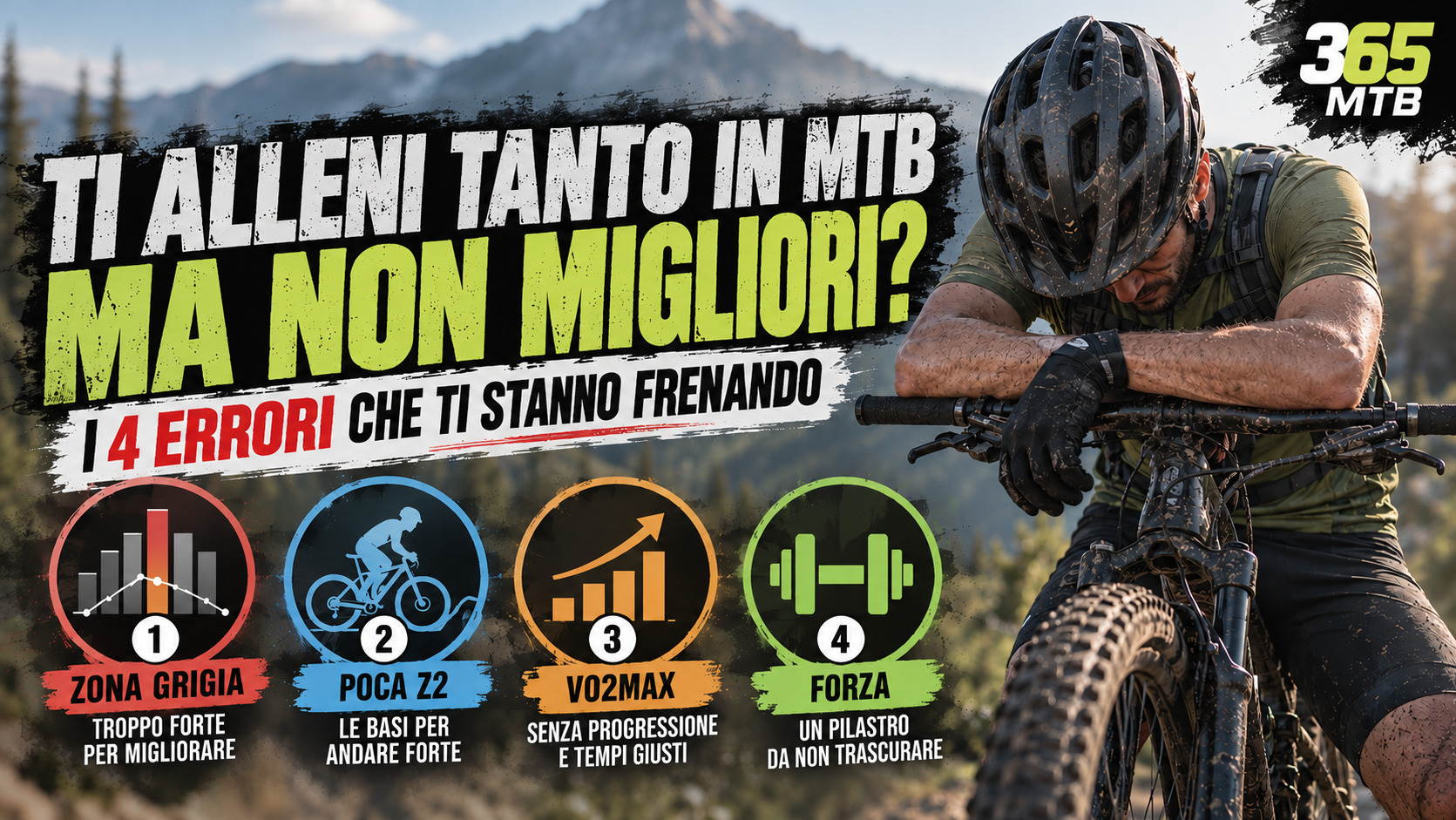
You ride your bike often, racking up miles, tackling climbs at full speed, and coming home tired. Yet, when you look at your times, your power output, or your sensations during the race, you realize something isn't right: you're not improving.
The problem might be the way you train.
In the world of mountain biking, there is still a belief that is difficult to dispel: the harder I work, the stronger I become.
But athletic training works differently.
It is not the amount of effort that determines improvement, but the quality of the stimuli, their distribution and the body's ability to adapt.
There are four mistakes I often encounter among MTB enthusiasts. Four habits that can turn many hours of training into results that are significantly below expectations.
Let's see what they are.
1. You're always training in the gray zone: too hard to recover, too unspecific to really improve.

It is probably one of the most common mistakes among amateur bikers.
You head out for a leisurely workout, but as soon as you hit a hill, you pick up the pace. You find another cyclist ahead and try to catch up. The route becomes challenging, and you end up pushing harder than expected.
The result? What was supposed to be an easy outing turns into yet another medium-intensity workout.
You often find yourself in the so-called gray area, that intermediate working range which, depending on the zone model used, is located around Z3 and can get close to the threshold.
Note: This doesn't mean the Z3 is useless. Medium-paced and tempo tasks have their own specific purpose in programming.
The problem arises when they become practically the only intensity at which you train.
Continuously working at intermediate intensities takes a significant physiological and muscular toll, without always leaving the necessary space for recovery and more specific stimuli.
In practice, you accumulate effort, but you don't build a sufficiently differentiated program.
The result? You're often tired, but rarely fresh enough to train really hard or relaxed enough to develop your aerobic endurance with a sustainable load.
The point is not to eliminate the gray area, but to stop living in it.
2. You don't do enough Z2: You want to go fast, but you don't build the foundation
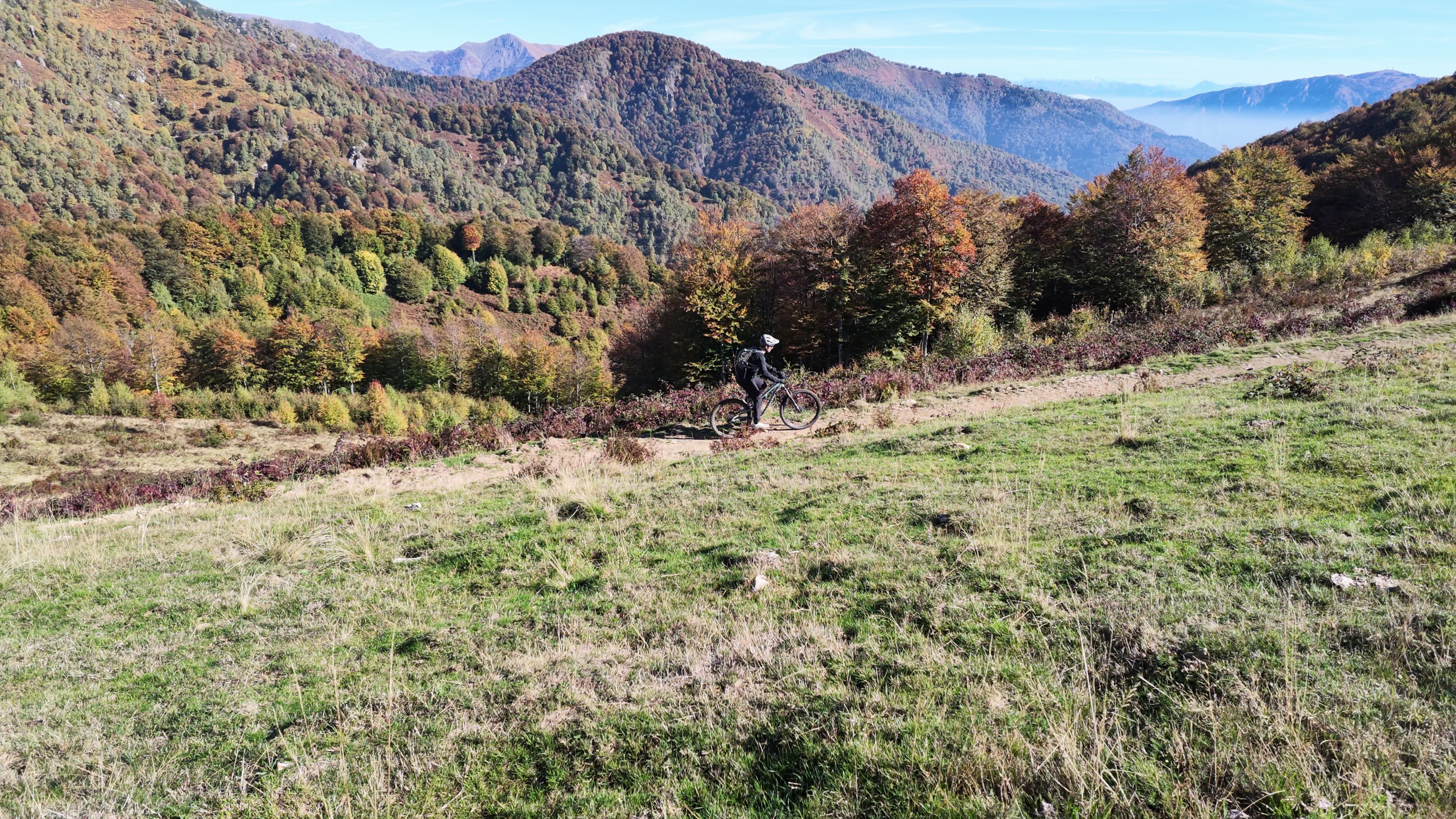
In recent years, thanks in part to the media attention surrounding champions like Tadej Pogačar, there has been a lot of talk again about aerobic training and slow distance running.
In reality, the Z2 isn't a recent discovery. It's one of the fundamental tools for endurance sports preparation.
Yet, for many bikers, pedaling slowly still seems like a waste of time.
"If I don't struggle, how can I improve?"
This is where the misunderstanding arises.
Z2 isn't about proving how strong you are today. It's about building the conditions to become stronger tomorrow.
When you work properly at low intensity, you stimulate fundamental aerobic adaptations: you improve the muscles' ability to use oxygen, promote mitochondrial adaptations, and increase metabolic efficiency.
Furthermore, good aerobic conditioning allows you to better sustain training volume and recover more effectively between efforts, together with proper rest and nutrition management.
For those who practice MTB this aspect is fundamental.
A race or a challenging ride isn't just about violent accelerations. It's also about long pedaling stretches, climbs, relaunches, and constant changes in pace.
The stronger your aerobic base, the better able you will be to handle these efforts without using up all your energy prematurely.
Of course, to talk about a true Z2, you need to correctly identify the training zones: the Z2 of a five-zone model does not necessarily coincide with that of a three-zone physiological model.
Slow running isn't a workout for those who can't push themselves. It's a part of the workout that allows you to push yourself when you need to.
3. You don't program your VO2max workouts and repetitions with the right progression
This is the paradox of many bikers.
They almost always train at sustained intensities, but fail to properly perform the high-intensity work that could produce the desired adaptations.
Why?
Because they arrive at specific sessions already tired.
Workouts like 30″/30″, threshold repeats or supra-threshold work require precise load organisation.
It's not enough to pedal hard.
You need to choose the right intensity, establish the duration of the intervals, manage recovery and, above all, introduce a sustainable progression over time.
Let's take the classic 30″/30″: thirty seconds of intense work alternating with thirty seconds of recovery.
They are an interesting tool for accumulating high intensity work and, when set up correctly, can help stimulate the high-power aerobic system.
But they are not a magic formula.
Their effectiveness depends on the intensity, the number of repetitions, the duration of the sets, the athlete's level and recovery.
The same goes for threshold and suprathreshold repetitions: they are different tools, with different physiological objectives, which must find their place in the programming.
If every outing becomes a race, when it comes time to do a real quality workout you no longer have the energy to perform it as you should.
The result is that you end up always training hard enough, but rarely in the way that is most useful for the goal you want to achieve.
The solution is not to add more repetitions.
It means creating the conditions to be able to perform them well, with the right frequency, adequate progression and sufficient recovery times.
4. You neglect strength: but in MTB, heart and lungs are not enough
When it comes to mountain biking training, all the attention is often focused on watts, heart rate, threshold, and VO2max.
But there is another fundamental component: muscle strength.
Not just the amount needed to push the pedals.
We also talk about the ability to stabilize the pelvis, control the trunk, manage the body on the bike and tolerate mechanical stress.
While pedaling, good stability of the lumbopelvic complex helps maintain an effective position and control unwanted movements.
When the terrain becomes technical, the discussion broadens further.
Descents, curves, compressions, obstacles, relaunches and changes of direction require coordination, motor control and the ability to produce and absorb force.
For this reason, a well-structured strength program can be a major advantage.
And we're not just talking about performance.
Muscles and tendons must be prepared to handle progressively increasing loads. Strength training, if properly dosed, helps increase the muscle-tendon system's ability to tolerate stress.
This doesn't mean that doing a few planks or a set of squats every now and then is enough.
It means building a program that includes strength exercises for the lower limbs, core work, stability, control, and load progression.
Strength isn't something to be added just when you have time. It's a quality to be trained as part of a biker's preparation.
The real mistake? Confusing tiredness with improvement.
If we look at these four problems, a common element emerges.
Many bikers don't train a little.
They train without a clear distribution of stimuli.
They do too much intermediate work, not enough truly controlled aerobic core training, intense sessions without a clear progression, and they neglect muscle preparation.
And so they end up accumulating fatigue without achieving all the adaptations they could develop.
Effective preparation must instead integrate the various components:
- Aerobic background, to build a solid foundation and support the volume.
- Specific high intensity work, to develop the qualities required by the discipline.
- Muscle strength, to improve neuromuscular abilities and load management.
- Recovery and progression, to allow the body to adapt.
There's no perfect distribution that works for everyone. An athlete who works five hours a week has different needs than someone who works fifteen. And a biker training for a marathon won't necessarily have the same schedule as someone competing in XCO.
But the principle remains the same.
Training well doesn't mean being exhausted at the end of every session. It means giving your body the right stimulus, at the right time, and the time it needs to transform it into improvement.
The question you should ask yourself
Next time you come back from a workout, instead of just asking yourself, "How hard did I work?", try asking yourself a different question:
"What quality did I train today and why?"
If you don't know the answer, maybe it's time to rethink your training routine.
Because in MTB, the winner isn't the one who gets more tired during training.
Those who are able to transform work into performance improve.


